Film Name: 黄飞鸿之三:狮王争霸 / Once Upon a Time in China III / 黃飛鴻之三獅王爭霸
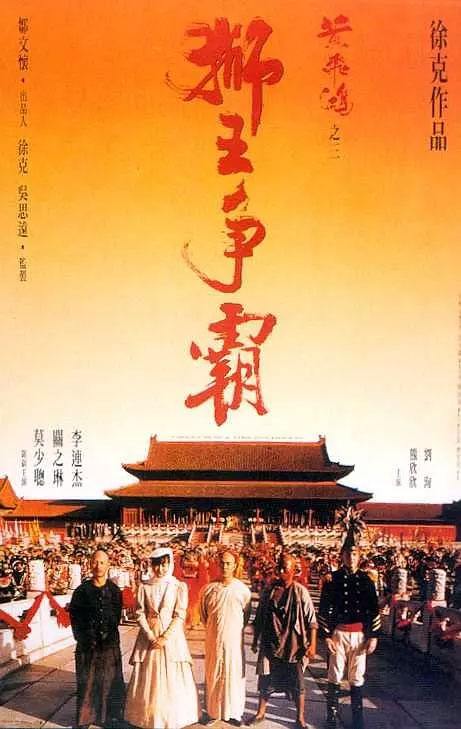
Watching Tsui Hark’s “Once Upon a Time in China III”
I recently came across an interview with Jia Zhangke where he mentioned that Hong Kong cinema subtly shaped his filmmaking perspective. He even stated that “Still Life” is structured entirely like a wuxia film: about seeking answers and resolving conflicts. I haven’t seen a single one of Jia Zhangke’s films, though I’ve always wanted to—especially after visiting Window of the World in Shenzhen, where I desperately wanted to see his “World.” But I never got around to it. I’m sure I’ll catch up with them all eventually!
But enough about Jia Zhangke. The other day I rewatched “Once Upon a Time in China III”—again on CCTV-6 Movie Channel. Lately they’ve been airing his films and Jet Li’s repeatedly. But honestly, whatever they show on CCTV-6 gets played over and over, often repackaged as themed series like “Tsui Hark Collection” or “Jet Li Collection,” making repetition inevitable. I can’t even recall how many times I’ve seen this one. My earliest memory is from upper elementary school, when they showed it as an outdoor movie. It was on that long, narrow road beneath the tall steps of our school building, with two tall poles set up and a big screen hung between them. I remember not seeing the whole thing that time. When I started watching, everyone was already saying “I love you” (I suddenly wonder if my memory is a bit muddled—we didn’t learn English in elementary school, so how would I know what “I love you” meant? It’s possible classmates learned it privately ahead of time, but I still feel a bit unsure). Back then, I was genuinely confused by the strange character of Auntie Thirteen—”she was from a different generation.” Beyond the final chaotic lion dance scene, the character that stuck with me most was “Ghost Leg Seven.” His leg techniques were filmed by Tsui Hark with such breathtaking, mind-blowing mastery that even Jet Li would likely feel a deep respect. But perhaps it was his story that truly moved me: abandoned by society, reduced to the scum of the earth, despised by all—yet finding one compassionate soul willing to take you in. What a profound sentiment!
This rewatch deepened my appreciation for these details, yet what truly resonates most in Tsui Hark’s Wong Fei-hung series is his exploration of two central questions: In turbulent times, what can an individual contribute to society? And how should one approach the clash between Eastern and Western cultures—what stance and actions are warranted? These themes intertwine with the recently popular discourse on the rise of great powers. The rise of a great nation should never be reduced to mere coincidence, for all nations are in constant pursuit of one another. When a nation suddenly ascends during a specific period, there are inevitably underlying factors at play (hindsight is 20/20). Yet, these same factors may simultaneously sow the seeds of future challenges (once again, the wisdom of our ancient sage Laozi rings true: “Misfortune is the foundation of fortune; blessings harbor misfortune). Yet passively awaiting fortune or misfortune to enhance oneself—especially to boost national competitiveness—seems unrealistic. (China’s ancient dynasties often leaned toward passivity, epitomized by the classic phrase “I have received my mandate from Heaven.” While this might have worked as propaganda during a dynasty’s founding, clinging to it as collapse loomed bordered on endearingly naive. Fundamentally, rulers throughout history are merely the competitive victors providing public goods in their respective eras). This inevitably raises the question of what attitude and methods to adopt in facing competition.
In Tsui Hark’s Wong Fei-hung films, several types of Chinese characters typically emerge when confronting such situations: The first type is completely Westernized, represented by Auntie Thirteen. This character essentially serves as an introducer of Western technology and values in nearly all Wong Fei-hung films. The second type opposes Westernization. This includes most Qing dynasty officials and certain principled martial artists (the Boxers being a historical archetype, with various secret societies also appearing in the films). The motives and behaviors of these two groups are diametrically opposed: the former aims to preserve their vested interests, manifesting as sycophantic flattery coupled with covert obstruction, or exploiting Western influence to suppress domestic populations. The latter seeks to maintain the established way of life, expressing total rejection—whether of Western goods or people. The third group remained indifferent to the West’s arrival, seeking only personal gain or the preservation of their existing advantages. Numerous individuals fell into this category, often depicted as a blurred backdrop: certain officials and vast numbers of underworld figures whose interests were inextricably linked to Western powers. They operated as compradors, colluded with whites in the trafficking of coolies and opium, traded arms, or oppressed the populace. The final and smallest group comprised enlightened individuals who transformed their sense of crisis into urgency, recognizing the need to selectively absorb Western technology and proactively engage in competition. Among them were a few officials (Li Hongzhang is portrayed as such a figure, which may seem puzzling to many mainland viewers but likely reflects his true character), intellectuals like Sun Yat-sen, and national industrialists directly facing commercial competition—such as Huang Qiying, the Baozhilin merchant who purchased steam engines. Their sense of competitive pressure was more immediate and urgent. Huang Feihong is also portrayed as such a positive figure here. Though he occasionally appears as a martial arts master who blindly rejects the West (perhaps a concession to the nationalist sentiments of the general Chinese audience for box office appeal), once he confronts reality and receives guidance from Auntie Thirteen, he generally embraces Western influences swiftly and makes pragmatic choices.
Is the portrayal of these characters successful? Or do they truly represent the authenticity of that era? After all, we are creating films about that time period decades later, and these Wong Fei-hung stories are largely scripted inventions. Does such analysis still hold meaning for understanding that historical context? Personally, I believe it serves as an artistic re-enactment of the past, offering warnings and lessons for contemporary audiences.
Many of these questions, in my view, are not issues commercial films should avoid. Commercial films should carry values because they are, after all, works of art. If your values aren’t embraced, audiences will reject them—the most glaring examples being the recent batches of notorious trash cobbled together by certain renowned mainland directors. This principle is evident in my limited exposure to Hollywood films: no matter how outlandish the plot, these movies invariably conclude with a happy ending where good triumphs over evil. Tsui Hark’s films embody this orthodox value system remarkably well (as I understand it, rooted first in Hong Kong society’s orthodoxy). His most compelling portrayal is the chivalrous consciousness cultivated by Chinese tradition—at times of national peril, one must uphold the state above and aid the weak and vulnerable below. As Jin Yong put it: The greatest chivalry is for country and people. Measured against this standard, the so-called wuxia films produced by mainland directors in recent years are utterly trash. They either sink into serving as mouthpieces for the state apparatus or devolve into nothing more than human meat grinders.
The chivalrous consciousness corresponds to civic consciousness. Whenever citizens’ distrust in the state system grows, the chivalrous consciousness rises. For this consciousness manifests first as a distrust in state-provided remedies and an expectation for private remedies. Though this consciousness may merely serve as a form of self-gratification for readers and audiences, its healthy development still requires cultivation. The current popularity of martial arts fiction on the mainland precisely illustrates this demand for such consciousness, though it remains immature. Or rather, this civic consciousness imbued with a sense of responsibility—the traditional martial arts ethos of serving the nation and its people—has lost its fertile ground in this era of diverse value orientations. The dominance of fantasy genres, where demons and monsters run rampant, can be seen as a collective rejection of modern society and a search for substitute sources of spiritual fulfillment.
There was once a saying (less heard now) that Hong Kong was a cultural desert. But I believe that if any cultural desert exists, it is not in Hong Kong. Or even if it were truly a desert (in terms of the scarcity of tangible cultural artifacts), it is precisely in such a desert that people develop a deeper appreciation and longing for water. As Wong Fei-hung’s Foshan Shadowless Kick was reenacted countless times before my eyes by various actors, it suddenly struck me: it is precisely these myriad incarnations of Wong Fei-hung—all embodying the same spirit of defying tyranny, embracing diverse influences, preserving civilization, and pioneering innovation—that have fueled China’s relentless rise.