Film Name: 暗花 / Am faa / The Longest Nite / The Longest Night / Hidden Reward
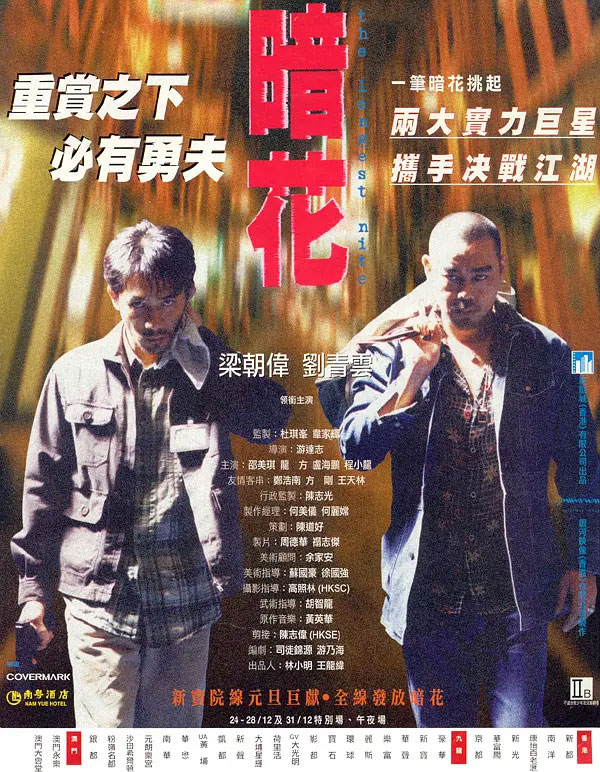
Upon finishing this film, my first thought was that it’s a classic. From the director’s vision to the actors’ performances, everything is superb—it still holds up to this day and is worth watching again.
I’ve always believed that a true classic is one where a hundred people can watch the same story and each feel something different. That’s why I feel compelled to share some thoughts about this film—things I’d feel uncomfortable keeping to myself.
The film opens with a voiceover establishing the central plotline. While this technique is clichéd and somewhat heavy-handed, it doesn’t feel outdated here because it shifted my perspective.
The central conflict revolves around Mr. Hong confronting two major gangs. From this point, Mr. Hong is introduced. The protagonist, Tony Leung, repeatedly echoes a line about Mr. Hong: “Anything can be resolved tomorrow night. Why fear Mr. Hong? He’s just some old man who hasn’t been back to Macau in over a decade (or decades). How dangerous could he be? If he’s really that formidable, I’d like to meet him myself.”
The opening credits mention “over a decade,” while the closing credits state “decades,” but both convey the same point: Mr. Hong hasn’t returned to Macau in a very long time.
At this point, many dismiss it as commonplace, so seemingly no one has bothered to scrutinize exactly who this pivotal, formidable Mr. Hong truly is. Of course, the film explicitly states he’s the mastermind behind Macau’s two major gangs, and most viewers accept this interpretation without issue. Yet upon closer reflection, one realizes Mr. Hong doesn’t fit the mold of a venerable elder respected throughout the underworld, nor is he merely a wealthy tycoon. Thus, whether envisioned as a Hongmen patriarch or a super-rich figure (like gambling king Stanley Ho), he remains only a shadow—never a perfect match.
First, Mr. Hong seems to operate quite openly. He publicly announced that George and Big Brother Ji must leave Macau, even threatening to clear the field. Yet George and Big Brother Ji didn’t comply directly or seek negotiations with him. Instead, they went into hiding, seeking an opportunity to form an alliance—arguably to deprive Mr. Hong of any “excuse” to clear the field.
By conventional logic, when a backroom boss has grievances against frontline leaders, he would either directly confront them and their uncles for talks or simply have them eliminated. There’s no need to make such a public spectacle (though some might argue this demonstrates Mr. Hung’s extraordinary wisdom). However, I believe this behavior suggests Mr. Hung’s intentions were more easily discernible.
Second, why hadn’t Mr. Hong returned to Macau all these years? Why did he suddenly want to clear the field? Was it merely because of eight months of turf wars between two major gangs?
Of course, it’s possible that the mastermind, residing outside Macau, simply refused to get involved in Macau’s affairs. But why choose this particular moment?
The film was released in 1998. At that time, Hong Kong had already been returned to China, while Macau’s handover was scheduled for the following year.
The “grounded” implication here is quite obvious. It’s not that Mr. Hong ignored Macau, but rather that he couldn’t intervene—Macau was leased to Portugal.
Third, what was Mr. Hong’s purpose in clearing the field? By eliminating the two bosses, was he seeking new proxies, or was he aiming for something else?
By the film’s end, who had perished? The Kee family, George and his underling, the corrupt cop played by Tony Leung, and the assassins portrayed by Lau Ching-wan and Siu Mei-ki.
Why must all these individuals—whether allies or adversaries of Mr. Hong—be eliminated?
Tony Leung himself admits he’s no model cop, content to take bribes without complicating matters. Yet Mr. Hong specifically selected him a month prior in his strategic planning. In truth, being chosen meant certain elimination.
Is eliminating these people merely about replacing them? No. Mr. Hong doesn’t even want those who could be easily bought off with money. How could it be just a simple replacement? In truth, the reason all those ambitious, intelligent, and daring individuals must be eliminated is for social harmony—to prevent similar incidents from occurring.
Having said all this, it should be quite clear by now. Chosen at such a critical moment, and with his penchant for a harmonious society, who is this Mr. Hong?
He is not some old ghost, but rather Red China—or more directly, the central government.
Of course, unlike me, who is perpetually suspicious of politics and views related matters as normal, the average viewer likely won’t perceive such a political metaphor. After all, the film does repeatedly show that elderly man in a long robe reading the newspaper while seated in a car.
But that’s how I see it. So from my perspective, this film carries more of a sense of current events than many perceive—it’s not merely the intricate plot or the relationship between personal ability and fate.
Did the characters in the film know about this current situation? I think the opening narration mentioning Mr. Hong was a hint that everyone knew he was coming back.
Perhaps it was precisely because they realized the tide had turned that Tony Leung remarked, after following Big Brother for over a decade, that no matter how fiercely they clashed with George, he remained composed—yet he had never seen him so afraid.
Different individuals in the film adopt varying strategies when confronting “Mr. Hong.” Naturally, most of them simply comply with his wishes—embodying the adage that “those who recognize the times are the true heroes.” Yet those represented by Tony Leung choose to swim against the current.
Ultimately, however, all the protagonists meet untimely deaths. This is precisely the film’s pessimistic core—the most despairing essence of a noir masterpiece.
Against this backdrop, it matters little how clever Mr. Hung’s choice of Lau Ching-wan was; how ingeniously he orchestrated his schemes; or how precisely he calculated that Tony Leung would flee by boat while George would return to Macau by sea; or the ubiquitous small-time characters who betrayed each other; or even the luck that saved Tony Leung’s life with his bulletproof vest, or the misfortune that led Lau Ching-wan to fall to his death while cutting the awning—all these are mere details, irrelevant to the whole. Even if some elements were altered, their fates would remain unchanged. It only serves to highlight the irreversible trend.
In truth, those present at the time viewed the event precisely this way, and the prevailing atmosphere mirrored this perspective. Consider today’s Occupy Central movement in Hong Kong—it too stems from this same vein of despair.
At this point, the film seems to lose its meaning. For the greed and cowardice of human nature, the yearning for life, and the astonishing plot twists are merely a beautiful veneer. The more one dwells on them, the more perplexed one becomes: why must it be this way?
By the film’s end, the director has Wang Tianlin utter the line, “Sometimes it’s best not to be too clever” (some things are beyond your wildest imagination).
Exactly. That’s all there is to it. No grand truths, no platitudes about effort yielding rewards, no defiance of fate. Instead, it carries the weight of “man’s plans cannot outwit heaven’s.”
Thus, “Mr. Hong” isn’t the central government at all—he never even appears. Yet every character dances to his tune. Even choices you believe are your own were long anticipated by him.
Mr. Hong is a concept, deliberately embodied as an old man to make this abstract idea more story-worthy.
It’s not that such a formidable protagonist must die, nor that minor characters will always escape unscathed. Innocence doesn’t guarantee survival, nor does heinous crime guarantee annihilation—it’s simply the way things are.
The director’s despair and distrust are laid bare, yet most audiences are captivated only by the story’s strangeness and the brilliance of the performances.
Thanks to the two Academy Award-winning actors, who gave their all in this film, a brilliant flower blooms even in this icy darkness. Faced with such a helpless story, one can only sigh or marvel at its brilliance, rather than feel profound sorrow.