Film Name: 子弹出租 / Bullet for Hire / 子彈出租
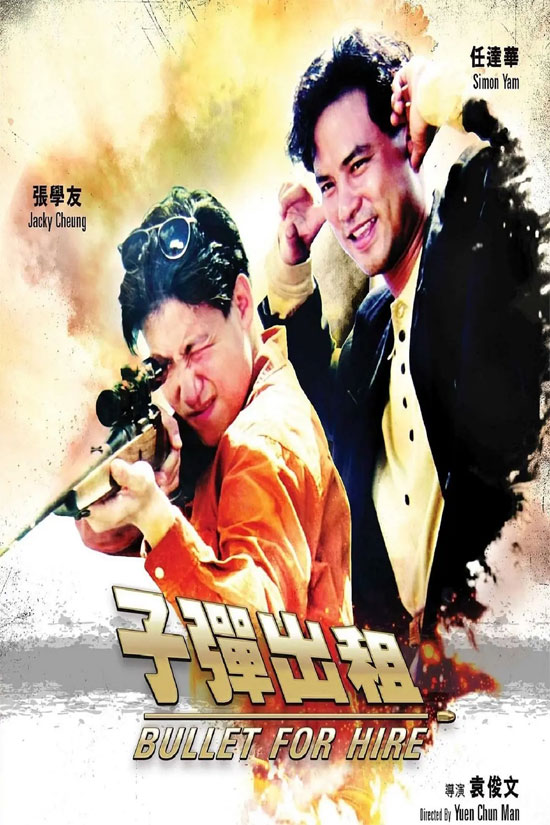
Hong Kong cinema, hitmen, Jacky Cheung, Simon Yam—with these elements, it’s hard not to give this old-school film a watch. While it didn’t blow me away, it didn’t disappoint either, so here’s a brief take.
Jacky Cheung, as always, plays a classic underling role, embodying the film’s tagline: “A hitman’s coming-of-age story.” Simon Yam departs from his usual villainous roles to portray a loyal and compassionate hitman. Lo Lieh portrays a reluctant, aging hitman caught in circumstances beyond his control.
Brother Yue (Luo Lie) and Brother Han (Simon Yam) are a hitman duo. Though Brother Yue is also Brother Han’s mentor, their personalities clash sharply. Brother Yue is religious, always praying before missions, while Brother Han lives recklessly—no relationships, no marriage, a carefree, live-for-today lifestyle. Their differing worldviews don’t hinder their bond; they’re both mentor and friend.
After one assassination, Yue senses his own aging and declining abilities. His boss, recognizing this, introduces a new recruit, Ah Shan (Jacky Cheung), for Han to mentor. Meanwhile, another aging hitman, Biao, who is on the run, is forced by the boss to commit suicide on the spot. The boss reneges on his promise to spare Biao’s wife and daughter.
This series of events unsettled Brother Yue, for he understood he now shared the same fate as the deceased Brother Biao—and he too had a daughter. A perfect assassin must be utterly ruthless; having a daughter created a vulnerability within him, a weakness that ultimately sealed Brother Yue’s tragic fate.
Ashan, young and inexperienced, exuded a rustic, naive air. On his first mission, he fumbled clumsily, brawled in a bar, and intervened for a massage parlor worker in the bathroom, developing feelings for her. Yet, with Han’s guidance, he gradually matured into a skilled assassin, forging a bond with Han along the way.
As the plot unfolded, Yue Ge’s vulnerability was exposed before an operation. The police obtained information about his daughter, and to ensure her safety, he had no choice but to cooperate with them. He sabotaged the assassination attempt and faked his own death to deceive everyone, fleeing abroad with his daughter. The boss saw through this scheme. He publicly sent Han Ge to deal with Yue Ge, while secretly dispatching Ah Shan with other assassins to lie in wait and ambush him.
At the critical moment, Brother Han, true to his loyalty, couldn’t bring himself to harm Brother Yue. The other assassins then emerged, raising their guns. Brother Yue turned to shield Brother Han from the bullets, sacrificing his life on the rooftop. In his final moments, he entrusted Brother Han to care for his daughter, Xiao Hui. Han fled with Xiao Hui, encountering Ah Shan along the way. Han stood in front of the gun, and Ah Shan, moved by loyalty, couldn’t pull the trigger. Yet Xiao Hui was killed by other assassins. Unable to fulfill his duty to protect the child, Han was overcome with grief. He fought fiercely against the assassins, killing them, but was wounded in the left arm by a bullet.
Ah Shan chose to stand with Han Ge, retrieving the bullet and treating his wound. The Boss sensed something amiss and attempted to kidnap Ah Shan’s masseuse girlfriend to blackmail him. Unexpectedly, the gun of the henchman he sent went off accidentally, killing her.
Loyalty and honor—the core values of Hong Kong gangster films—shine a light on humanity while simultaneously tearing hearts apart, condemning souls to a life of crime. Brother Yue, Brother Han, and Ah Shan are all men of honor, while the Boss stands in stark opposition: breaking promises, cold and ruthless. A clash between the two sides becomes inevitable.
At the climactic showdown, Han and Ah Shan together couldn’t overpower the Boss. With both Ah Shan and himself gravely wounded, Han disregarded his own safety, detonating gas in a suicide attempt to take the Boss down with him. Yet he was killed in the blast while the Boss survived.
In the final scene, Ah Shan struggles to his feet, strangles the Boss to death, and lets out a furious roar. He’s lost his girlfriend, his brother, and stacks of cash, but he’s become his own man—preserving his loyalty and regaining his freedom. The story of a hitman’s growth: for a killer, true maturity isn’t about eliminating partners or colleagues, but about taking down the Boss himself.