Film Name: 义胆群英 / Just Heroes / 義膽群英
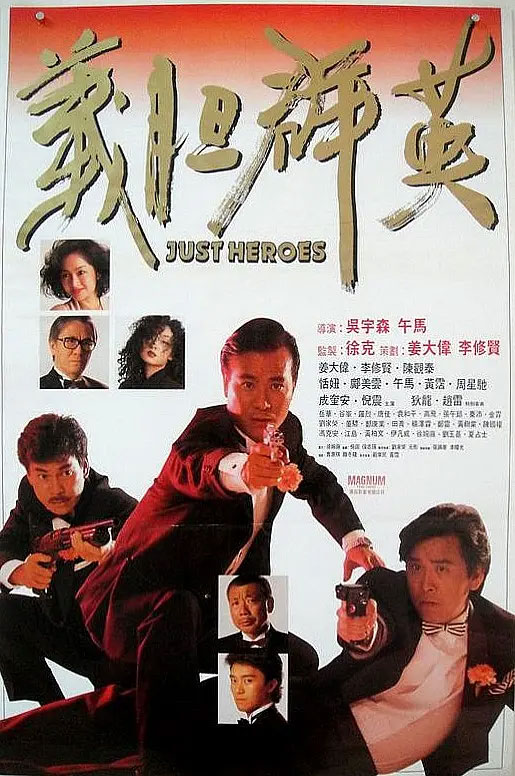
“Just Heroes”
A star-studded film—even though I’ve seen few Hong Kong movies, I still recognized many familiar faces, all once-glorious superstars.
But since I’m not very familiar with most of them, nor with films from that era, I won’t dwell on them. Though written by Ni Kuang, the plot follows tired tropes—best left unsaid. The three leads are well past their prime yet still engaged in romantic entanglements, which feels like a misstep. Younger audiences likely prefer handsome men paired with beautiful women. I won’t dwell on the trio either. My only reason for watching this film was Stephen Chow’s appearance, so I’ll focus solely on his character, Xiao Qi.
Xiao Qi is Ah Tai’s subordinate, a loyal and honorable man who trusts his boss implicitly—even willing to take the fall for him in prison. Yet he’s also impulsive and single-minded. His unwavering loyalty leads him straight into a dead end; he remains oblivious to the betrayal until the very end, when Ah Tai silences him. Even then, he refuses to believe his boss would ever sell him out.
He’s a tragic figure, utterly tragic. Unlike some of the petty thugs he’s played before, he has none of the cunning or slickness. He’s serious and earnest, a brainwashed, loyal fanboy of Ah Tai. When he turns himself in for Ah Tai, he declares: “You’re my big brother. You’ll always be my big brother.” Sadly, this brother ultimately betrayed him, even silencing him by murder. In prison, he was stabbed to death by a group wielding toothbrushes. Blood gushed from his abdomen and mouth, yet he gasped, “Tai wouldn’t do this to me.” What did his eyes reveal? Shock? Disbelief? Rage? Resentment? Or perhaps a hint of regret?
Suddenly I recalled Atai telling Xiaoqi in the car earlier: “If you ever get the chance to be a big brother, the most important thing is to stand tall and keep your head held high. Even if you get stabbed twenty times, you can’t fall. You need to have vision and ideals—that’s what makes a good big brother.” Xiaoqi replied, “Thanks for teaching me. I know I’m not cut out to be a big brother.” At the time, I still believed Atai couldn’t be the one who killed Mr. Cao. But as the plot unfolded, Atai’s expressions—especially when Xiaoqi offered to turn himself in in Atai’s place—suddenly made me realize Atai wasn’t a good man. Xiaoqi seemed to have been deceived. It couldn’t have been Xiu who killed Mr. Cao. The real mastermind behind it all had to be Atai.
Watching Xiaoqi say, “You’re my big brother, and you’ll always be my big brother,” with such unwavering conviction, I suddenly felt that trust was deeply ironic. Right up until the end, when Xiaoqi was killed in prison by someone sent by Atai, his eyes remained wide open in death—filled with unyielding resentment and shock. left me baffled. Why did it have to be this kind of character? Initially, when Xiaoqi schemed to frame A-Xiu and injured his girlfriend, I felt some resentment toward such tactics. But witnessing his final fate, it all suddenly felt profoundly tragic.
In the underworld, one’s fate is often beyond their control. Perhaps Xiaoqi trusted Atai too deeply, leading him to be deceived. He was manipulated into committing wrongdoing, ultimately meeting a tragic end in prison—a perfect illustration of the saying, “What goes around comes around.”
This time, Stephen Chow’s character carries an even deeper tragic weight. Due to his subjective choices, I believe he is the most tragic figure in the entire film—indeed, the most tragic character I’ve seen in Stephen Chow’s works in recent memory. His fate surpasses even that of Ah Chi in The Dragon and the Phoenix, Ah Sing in The Wind Catcher, and Ah Yau in Dragon in the Sky. Those three characters at least had friends and brothers to rely on, whereas Xiao Qi here is exploited, ultimately betrayed and silenced. The tragedy he embodies carries an added layer of desolation.
This production was packed with A-list stars, while Stephen Chow was merely a newcomer just starting out. Though he’d appeared in a few films before, he couldn’t compare to these heavyweights. That he delivered such a standout performance in this environment speaks to his relentless dedication to honing his craft.
Time flies. Today, the big names of that era have long faded from the silver screen, yet the young hustler who once played their sidekick and supporting roles still strives on. Even with graying temples, he continues to pursue his dreams in the world of cinema.
One era ends, another begins. Yet I firmly believe Stephen Chow’s era will never fade. Even ten or twenty years from now, people will still remember him—the man who accompanied my growth, bringing me endless joy and emotion.