Film Name: 得闲谨制 / Gezhi Town
Last night I finally caught the new film “Gezhi Town.” Before seeing it, I’d already heard mixed reviews about the movie—it’d be a lie to say I wasn’t curious… Now I can share my own thoughts.
To cut to the chase, I generally approve of and appreciate this “non-mainstream” war film. It shifts the focus to a group of civilians and retreating soldiers during wartime, zeroing in on their unsavory actions and negative emotions. It blends dark humor with genuine emotion, meeting my basic expectations for a screenplay by Lan Xiaolong.
Yet the problem may lie precisely here. Kong Sheng and Lan Xiaolong (still under the Zhengwu Sunshine banner) brought over many TV drama conventions, resulting in occasional hardware-software incompatibility glitches and oddities. The most glaring issue is the overly dense and heavy dialogue, making the film feel somewhat excessive and affected in its actual viewing experience.
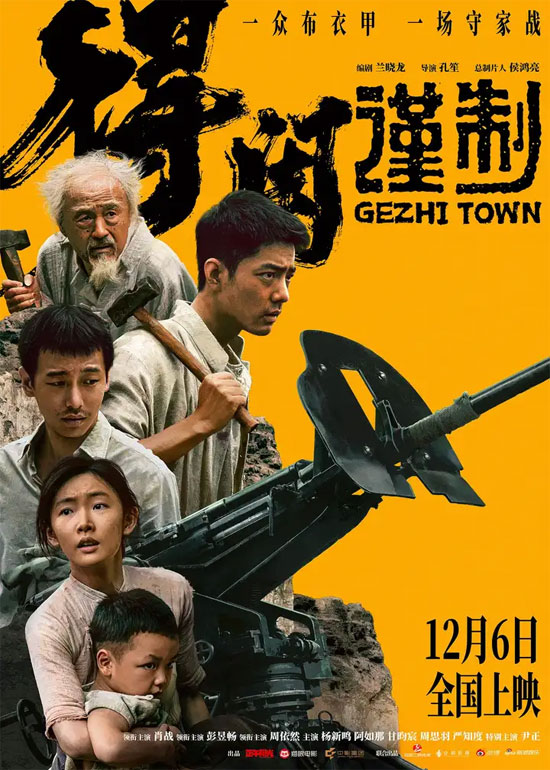
First, the strengths of “Gezhi Town”: its perspective and setting are well-chosen.
Mo Dexian, a determined yet fleeing anti-Japanese machinist, and Xiao Yan, a boastful yet cowardly artilleryman, have been retreating westward since 1937—from Nanjing to Yichang, then to the desolate Gezhi Town. Alongside their families, comrades, and fellow refugees, they find temporary respite in this “utopia” before inevitably encountering three lost Japanese soldiers.
“They’d forsake their lives for comfort. My appreciation for “Gezhi Town” stems largely from its uncanny resemblance to “My Chief and My Regiment.” The petty cowardice of ordinary folk, the brutality and absurdity of wartime—it all erupts like a geyser. Here, there’s no trace of conventional heroism or grand national narratives. Only the dust-covered souls of small characters, their courage and backbone emerging spontaneously yet belatedly.
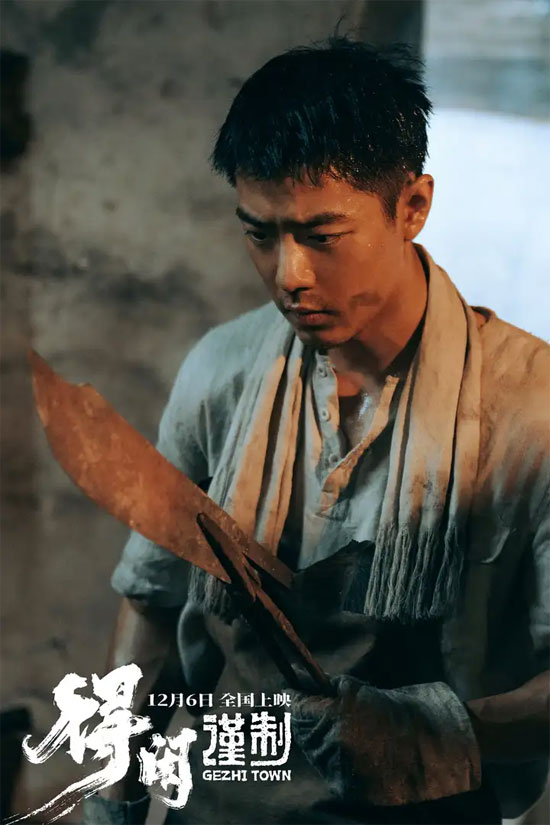
Xiao Yan epitomizes this. As a deserter, he’s something of a legend—fleeing westward for years while somehow retaining his Su Luotong cannon and gathering a band of new and old stragglers. Yet these possessions seem more like facades preserving his illusion of being “still a soldier of the resistance.” After all, neither his cannon nor his men had truly fought the Japanese before reaching Gezhi Town…
Mo Dexian, however, was Xiao Yan’s atypical mirror image. He had earned a detached status through his craftsmanship and spent his days sneering at Xiao Yan and his men as dullards and scoundrels, as if he alone embodied the true spirit of resistance. Yet he had done every single thing expected of an ordinary commoner: escorted his grandfather through the turmoil, married, and raised a family.
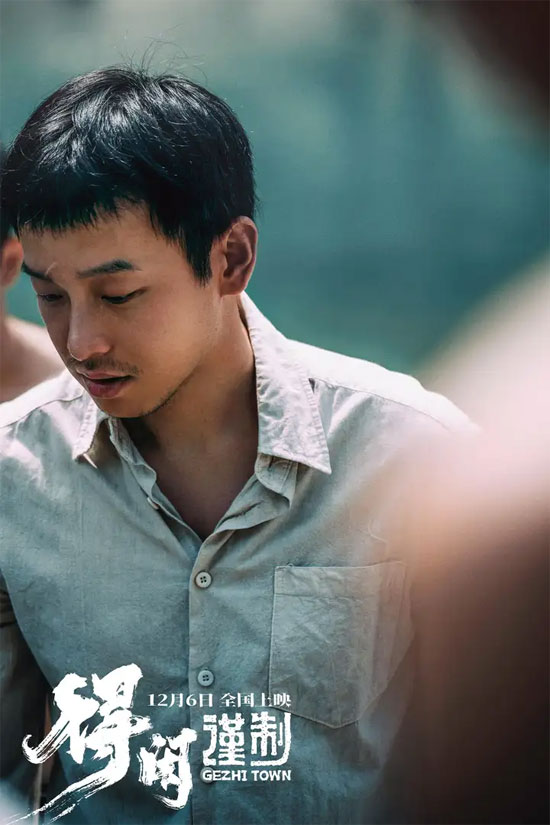
Only when the Japanese invaders’ forces swept before them once more were they jolted by blood and death into the inescapable reality of their plight, developing spines that were somewhat twisted, somewhat laughable, yet incredibly resilient and profoundly admirable.
Logically, “Gezhi Town” should be compelling given its aforementioned strengths and merits. Yet in practice, the film often suffers from poor pacing and viewing experience—ironically stemming from its own virtues. The colorful ribbons meant to adorn and elevate the tanks become the very ropes that constrain and disrupt their performance.
From start to finish, the film cultivates an air of “apocalyptic poets chanting cautionary wisdom,” delivering a relentless barrage of memorable lines that leave one dazzled. Here’s a random sampling, including but not limited to:
Die like one man, but charge forward like a multitude.
Will you flow with the current, or swim against it?
You can be sent to die, but don’t seek death yourself.
I merely died; you merely didn’t.
Tear me apart, then use my flesh and blood to tear him apart.
And so on…
The above are relatively straightforward. But “Gezhi Town” is littered with lines requiring two or even three twists to grasp. While this should be a strength, cramming so many “golden lines” together makes it feel like a chatterbox who can’t speak properly.
If this were a TV series with ample runtime, audiences would naturally have the capacity to absorb, digest, and appreciate such narrative pacing and linguistic style. But this is a mere two-hour film—viewers’ time and energy are relatively limited. When creators insist on cramming so much into a single release, the final product’s texture inevitably suffers.
Take the opening scene where Mo Dexian and the old patriarch flee by boat—their debate over whether they’re on the Yangtze or Yellow River reminded me of the regional cuisine quibbles during Long Wenzhang’s trial. The core sentiment conveyed is the desolation and rootlessness of a nation shattered while its mountains and rivers remain, of having no home to return to. Yet, without proper groundwork, this convoluted lament feels less like sorrow and more like sheer nonsense…
Even someone like me, who prides myself on having decent focus, had to admit moments of disorientation during the viewing. Just as I was processing one line of dialogue, another roundabout line would come along… If the film had cut its witty lines in half, toned down the bard-like quality, and opted for more plain language and down-to-earth authenticity, I believe it would have garnered more praise.
Even so, I still love “Gezhi Town.” Its unique blend of “notorious yet vividly authentic” qualities remains a rare gem in Chinese cinema.