Film Name: 镖人:风起大漠 / Blades of the Guardians: Wind Rises in the Desert
After the second day of the Lunar New Year, the projected box office figures for all new films in this year’s Spring Festival season were revised downward—except for “Blades of the Guardians: Wind Rises in the Desert” (hereafter referred to as “Blades of the Guardians”), which saw an increase. Its opening score on Douban was 7.5, significantly better than my earlier pessimistic forecast—
I had anticipated the film would face a critical collapse and box office disaster upon release. This wasn’t due to a lack of confidence in action veterans like Yuen Woo-ping and Wu Jing, but rather because wuxia action films have effectively become outdated. The notion that “chivalry breaks the law through martial arts” no longer represents (nor is it encouraged as) the mainstream social ideology, and this spirit has found better, more suitable vehicles. As a high-budget, large-scale production bringing together generations of martial arts masters and action actors, “Blades of the Guardians” seemed perfectly suited to serve as the funeral procession for this genre.
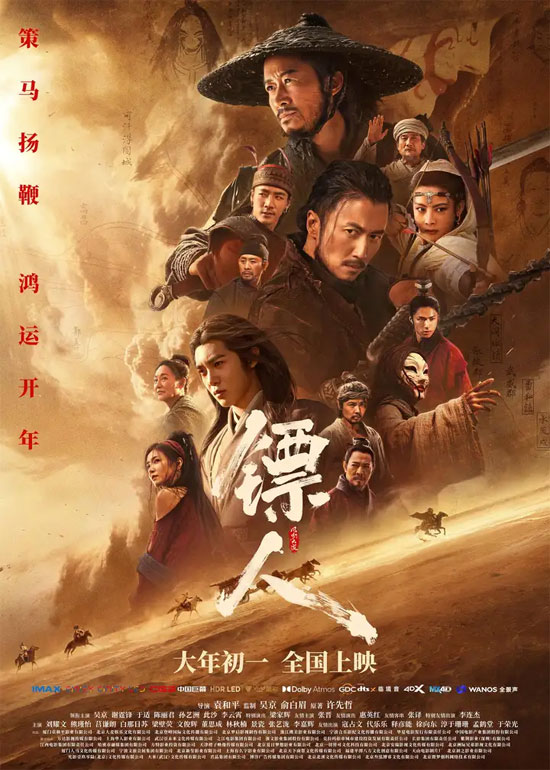
The film lived up to my expectations—it wasn’t particularly compelling. The dramatic scenes offered little substance, and the main characters lacked standout moments… Yet after watching it, especially with the relentless barrage of action sequences bombarding my eyes and brain, my perspective shifted: Should such stunning martial arts choreography and uniquely world-class action sequences simply fade away according to “objective laws”? Does my notion of “objective” necessarily dictate the future’s course?
Thus, subjectively speaking, I’ll give “Blades of the Guardians” a positive review. I admire its all-or-nothing ambition, its “sink or swim” spirit. I hope it recoups its investment and that a sequel sees the light of day.
[Spoiler-free divider.]
Disclaimer: I haven’t read the “Blades of the Guardians” comics or watched the animated adaptation. The movie was my first encounter with this IP. I understand the dissatisfaction and criticism from original fans, though I can’t fully relate… But this also has an advantage: I could watch the film without any preconceived notions. Many potential pitfalls from comparisons or expectations simply didn’t apply to me.
I won’t dwell on the lackluster plot and characters. Instead, I’ll focus on the film’s strengths in visuals and action sequences.
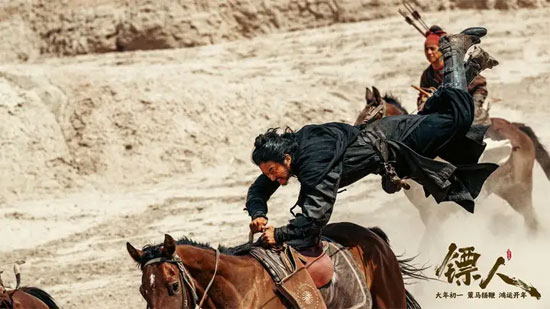
The first thing “Blades of the Guardians” wins over audiences with is its scenery and scale—the landscapes of Northwest China (Xinjiang) are breathtakingly beautiful. Vast stretches of desert and Gobi, dotted with small oases and villages, feel like a stage tailor-made for wuxia tales.
Additionally, the large-scale horseback combat sequences in “Blades of the Guardians” rank among the most thrilling I’ve seen in recent years. Beyond conventional mounted archery, sword fights, and chases, the film incorporates numerous equestrian stunts demanding exceptional rider skill, enhanced by the environmental effects of sandstorms and dust. The actual execution is remarkably impressive.
Of course, as a martial arts action film, the core and most valuable selling point and highlight of “Blades of the Guardians” remains its diverse array of action sequences.
Several fight sequences are currently being widely discussed: for instance, the sword-horse duel against Chang Guiren in Red Sand Town, where Jet Li proves he’s still got it, delivering a solid and elegant traditional martial arts exchange with two mid-career fighters; or the sword-horse battle against Shu in Black Bull Beach, where nighttime, flaming oil, and flashing swords create a rich and dangerous environment that adds significant excitement to this weapon-based fight.
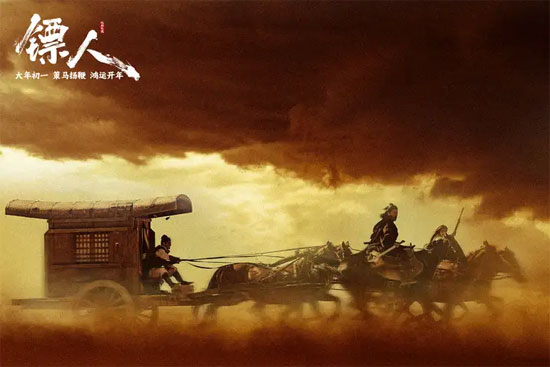
My favorite scene in the entire film is the chaotic melee where Dao Ma’s group, the three great tribes, and Di Ting successively charge into the sandstorm. This sequence showcases ingenious design that seamlessly integrates character movements with environmental elements, delivering an exceptionally potent blend of novelty and exhilaration.
First, Ayuya turns back to shoot down the leaders of the three tribes. Outnumbered and outgunned, she should be a fragile target easily crushed. Yet, harnessing the immense kinetic energy of the wind at her back, Ayuya’s arrows and sheer momentum overwhelm the pursuing force fighting against the gale. Her roar, “I am the sandstorm!” feels perfectly justified.
Next, Daoma and Diting battle while steadying themselves against increasingly fierce winds and sand. Their weapons must not only strike opponents but also be repeatedly planted into the ground to prevent being blown away. At the most extreme moment, the two even lock in a slanted grapple against the storm, fully embodying a clash between “Heaven, Earth, and Man.”
The climactic chain of battles in Mo Jia Village in “Blades of the Guardians” is equally spectacular. The film features multiple confrontations with diverse opponents and fighting styles, ensuring a rich and exhilarating viewing experience.
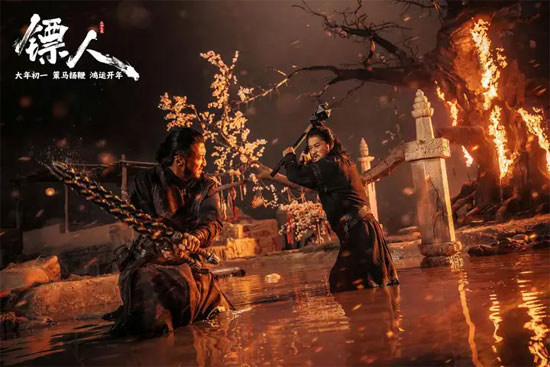
First comes the chaotic clash between Daoma and Shu versus Heixuan, where master swordsmen unleash unstoppable slaughter—pure adrenaline-pumping action. (Incidentally, this year in “Blades of the Guardians,” Sha redeemed last year’s regret from “The Shadow’s Edge” by successfully slaying Tony Leung).
After Hei Xuan’s retreat, Arhat and his Ironclad Mercenaries seamlessly take over. Dao Ma and Shu then clash with heavily armored warriors—clashing blades, heavy blows, and a much more grounded rhythm and texture;
The climax, of course, is the boss battle between Dao Ma and Di Ting—a clash of twin maces versus twin flails. It masterfully blends the brutal impact of blunt weapons with the fluidity of martial arts, culminating in a decisive victory achieved by sacrificing life for victory with a long sword.
Throughout, the film intersperses lower-intensity encounters—Peixingyan vs. Heixuan, Shu vs. Weizhi, Ayuya vs. Heixuan—adding nuanced visual variety.
Frankly, the acting in “Blades of the Guardians” is largely unremarkable. Only Chen Lijun, portraying Ayuya, delivered a genuinely refreshing surprise.
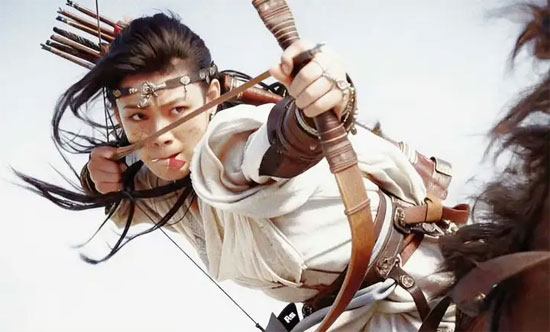
Setting aside the controversies surrounding the film, I reflected that while Nairnasi might have had advantages for the role—such as a more fitting ethnic minority appearance and stronger equestrian combat skills—her performance in dramatic and emotional scenes likely wouldn’t have stood out.
What impressed me most about Chen Lijun was precisely that she didn’t initially “look like Ayuya.” excessively refined yet lacking the necessary grit. Ironically, this very quality amplified the impact of her portrayal: the lively, willful longing for Chang’an in the first half, and the vengeful, frenzied obsession in the latter half, achieving twice the result with half the effort. What often felt like a weakness in “Blades of the Guardians” became an unexpected strength in her performance.
Moreover, upon checking, both Chen Lijun and Li Yunxiao (who played Yanzi’s Mother) hail from our Zhejiang Xiaobaihua Yue Opera Troupe—transitioning from opera performers to action actors is indeed promising. Foundational elements like posture, physique, movement, and expression are highly transferable. Setting aside the astronomical cost implications, the large-scale recasting and reshoots for “Blades of the Guardians” could be seen as a blessing in disguise.
Finally, I’d like to reiterate why I hope wuxia action films like “Blades of the Guardians” continue to be made.
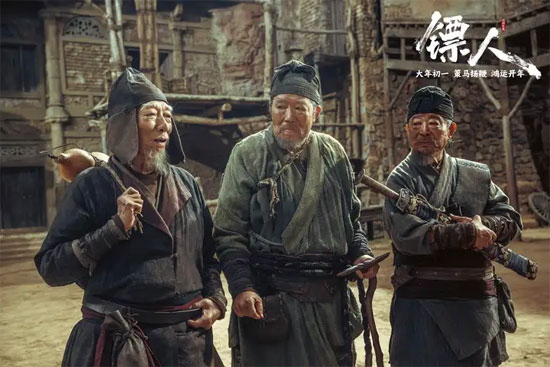
After the film concludes, Yuen Woo-ping, Zhang Xinyan, and Wu Bin gaze expectantly at a young man embarking on his martial arts journey. Both on and off screen, their hope for “passing the torch and nurturing the next generation” is unmistakable. This sparked a thought I’d also pondered while watching “Fight Against Evil 3” last month: Why do we still crave wuxia and action films today?
Especially now, with AI technology advancing by leaps and bounds, where highly precise and polished action sequences can be generated almost instantly. How much value remains in the authentic, bone-crunching martial arts of real fists and feet?
Beyond the potential for continuous innovation, it likely comes down to that indelible yearning for authenticity deep within the audience. That spirit of “I know it, I can do it” is irreplaceable. It will be the most precious commodity amidst the future flood of cheap imitations.