Film Name: 10间敢死队 / Being Towards Death
Last night, I finally caught up on *Being Towards Death*. The flood of rave reviews and buzz leading up to the May Day holiday, coupled with its unremarkable box office performance during the holiday itself, left me with a mix of curiosity and speculation as I watched it…
To sum it up briefly: As a comedy exploring the theme of “facing death,” *Being Towards Death* is quite good—it might even be director Chen Sicheng’s best film to date. However, perhaps Chen Sicheng truly lacks the talent and spark needed to make that leap from “good” to “great.” Even though the two-hour film had no major flaws or shortcomings, I still felt it lacked that deep, heartfelt resonance.
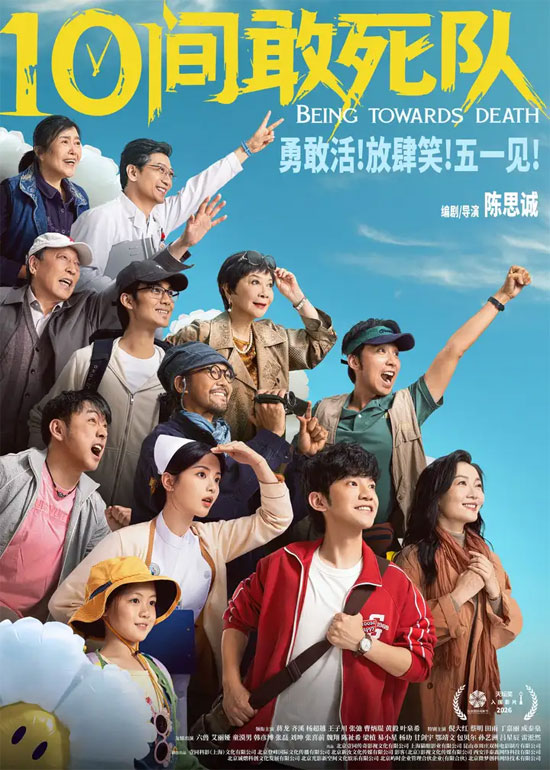
Actually, my first impression of *Being Towards Death* wasn’t great. The pacing was too fast and the film felt noisy. The protagonist, Zhang Xiaobing, came across as slick, frivolous, and talkative, while the other patients seemed perpetually in an over-the-top, “I’m acting” state. It followed a very clichéd narrative template of “the down-and-out and the dying preparing to redeem one another.”
However, as Zhang Xiaobing becomes a caregiver in Ward 10 and the perspective shifts to an ensemble drama, the film begins to find its stride. Although the characterizations of these patients and their families are overly archetypal—spanning “men and women, young and old, rich and poor”—and inevitably feel contrived with their forced solidarity and deus ex machina moments, the characters and their storylines are solid.
What I appreciate most about *Being Towards Death* is probably that it is “neither mournful nor maudlin”—from the perspective of a work dealing with the theme of “death,” it’s quite rare to conceive of and achieve this. Chen Sicheng has truly made the relationships between people (rather than life and death) the narrative focus of the film.
Specifically, the film doesn’t spend much time on resuscitation efforts, farewells, or the emotional reactions that typically accompany them. Instead, it devotes significant screen time to Zhang Xiaobing’s research project on “psychological intervention” and Jia Dao’s documentary, using these to weave together the dilemmas of all the characters and their interactions. As a result, what the audience sees isn’t “waiting to die,” but “living.”
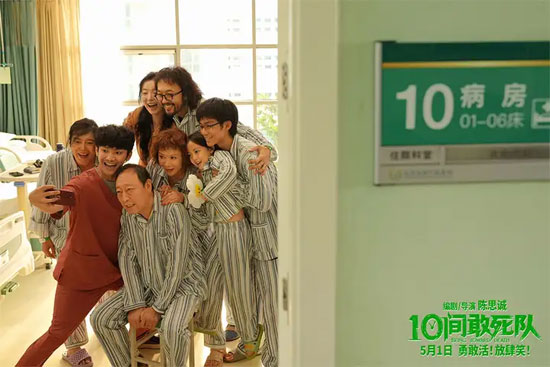
By the way, Chen Sicheng has finally learned to poke fun at himself. The film is peppered with directorial quips and inside jokes from the Chinese film industry (my favorites are Bao Bei’er’s outburst and Zhen Ai’s warning to Liu Wanpeng not to invest in movies and fall into a trap), and these moments feel increasingly natural. This is likely one of the reasons *Being Towards Death* has won over so many movie fans.
That said, even with all its merits, I still find myself lacking that “expected” level of affection for the film. Perhaps it’s related to what some have said about Chen Sicheng: “He has craftsmanship, but lacks talent.”
You can see just how well-structured, technically polished, and concisely narrated *Being Towards Death* is—in short, it’s shot with great maturity and sophistication… But as soon as you raise your standards slightly, or expect a bit more from the film, you can’t help but feel like something is missing.
Perhaps the taste of “industrial saccharin” hasn’t been fully masked? Even though Chen Sicheng has worked hard to hand-knead it the old-fashioned way, he still can’t achieve the natural sweetness of organic food. Given this premise, the reliance on past flavorings and seasonings actually serves to enhance the aroma and freshness—a bittersweet case of fortune and misfortune intertwined.