Film Name: 给阿嬷的情书 / Dear You
Those of us who are a bit older have likely lived through an era when we wrote letters to family, friends, and pen pals. I, too, occasionally reminisce about my school days—writing letters to like-minded classmates just to chat idly, or exchanging updates with a girl I had a crush on. Back then, communication wasn’t very efficient, yet our hearts were more easily filled with anticipation and excitement.
But when we extend the temporal and spatial distance between correspondents, condensing every precious word of longing and hope into brief, sparse letters, we witness the unbroken bonds of affection that have endured on this land for millennia—this is my greatest takeaway from watching “Dear You”: I was overwhelmed by a torrent of words and emotions, the impact lingering so powerfully that I couldn’t shake it off for a long time.
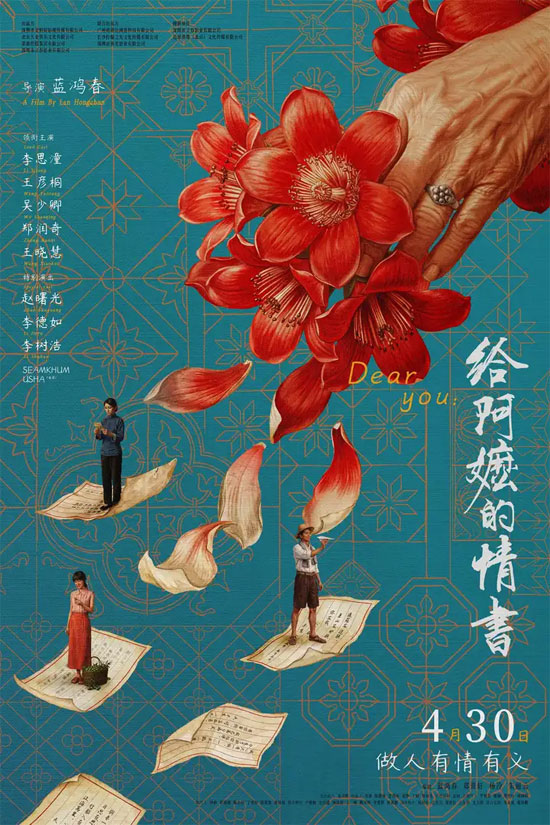
Although “Dear You” is a story created by director Lan Hongchun based on a Chaozhou family, the film’s universal themes have completely transcended regional boundaries; anyone capable of feeling emotion will be moved by it.
The film tells the story of Ye Shuruo, a Chaozhou-Teochew grandmother, who accidentally discovers the truth about her husband Zheng Musheng—who had gone to Southeast Asia decades ago—and his life in Thailand. After her husband’s untimely death, it was his close friend Xie Nanzhi who had been supporting her all along. This story, hidden for over half a century, slowly unfolds.
The greatest strength of “Dear You” lies in its compelling narrative and masterful storytelling: Through the actions of Ye Shurou’s grandson, Xiao Wei, who travels to Thailand to ask his grandfather for money, the film gradually unravels the truth. Yet, as the truth is revealed, it weaves in numerous clues and resolutions along the way. Without leaving the audience hanging on suspense, the film uses constant shifts in perspective and layered narrative twists to naturally reveal the full story.
The most compelling aspect of the plot is undoubtedly Xie Nanzhi’s decision to conceal Zheng Musheng’s death and instead write letters herself to Ye Shurou, sending her living expenses—a practice she maintained for nearly twenty years. The two women unconsciously formed a relationship of mutual support, only for this deep bond to be put on hold for four decades due to a dramatic misunderstanding.
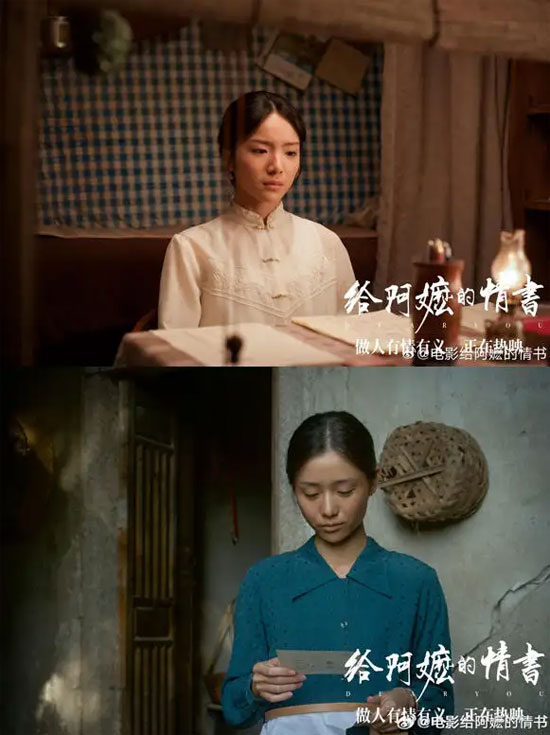
In handling this kind of plot—which could easily have been overly sentimental or melodramatic—”Dear You” consistently maintains an incredibly down-to-earth restraint. There are no loud sobs or outbursts, no pouring out of one’s heart; instead, there is a profound and enduring depth that strikes like a bolt from the blue.
Take the scene where Shu-rou and Nan-zhi meet, for example. I had imagined countless possible ways for this moment to play out—both good and bad—but I never expected that Nan-zhi would have lost most of her memory by then. With tears in her eyes, Shu-rou gripped her hand tightly and offered her an olive she had grown herself… And when Nan-zhi finally remembered Shu-rou, all she asked was, “Did you get the salted pork I sent you?” ” “If you liked it, I’ll send you some more.”
Based on its brilliant storytelling and character development alone, “Dear You” is already an excellent film, but it moved me far beyond that, because it sparked in me a strong urge to “add value” to it. What I most urgently want to express is my love for the Chinese language, for written Chinese, for family letters, and for love letters (which is why I couldn’t help but share those heartfelt reflections at the beginning of this article).
The film features a wealth of letters that are both concise and deeply moving. The combination of those touching words and their pronunciation not only fully embodies the aesthetic beauty of our language but also serves as a precise illustration of the film’s themes.
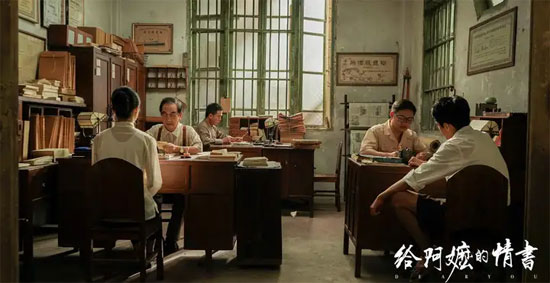
When you want to express longing and concern, you can write simply, “It has been more than eight years since I parted from my wife, and I think of her day and night.” For a more poetic touch, you might write, “Though we are separated by thousands of miles of rivers and seas, as long as I think of you in my heart, the distance feels nonexistent.”
When wishing to convey concern and blessings, one might write: “Though Siam is far away, my heart remains with you; as if we were neighbors, I pray for your safety—for that is true reunion.”
When wishing to express a spirit of joy and relentless striving, one might write: “I channel my longing into hard work and build my livelihood through diligence and frugality.”…
Not a single instance of the word “love” appears in these hundreds of overseas letters, yet the lines are filled with deep affection.
Building on this, I’d like to highlight another remarkable strength of *Dear You*: through the story of one family, it vividly captures the underlying spirit of their hometown and homeland—marked by hardship, resilience, mutual support, and a deep commitment to preserving traditions.
Even while busy working to earn a living, Mu Sheng always insisted that Nan Zhi and the children study, recite poetry, and learn to read and write. This was not only a practical skill to change their fate but also the root system through which these rootless wanderers, adrift in a foreign land, could pass down their cultural memory.
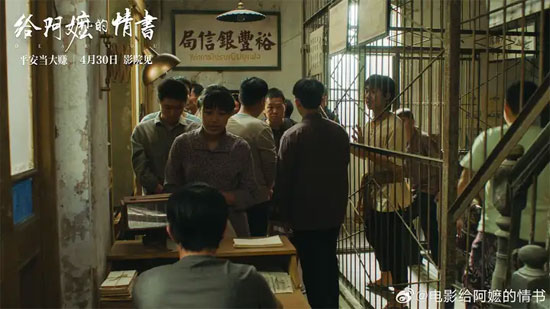
In “Dear You,” we see so many behaviors unique to Chinese families and fellow villagers—such as the older generation sacrificing themselves to support the next, or fellow villagers always offering whatever help they can. This spiritual bond can even transcend blood ties, forming a connection sustained by emotional projection and shared identity.
Mu Sheng’s story is the perfect illustration—he settled in Siam thanks to the support of fellow Chaozhou natives. Though notoriously frugal in his daily life, he sent every penny he saved back home. Diligent, righteous, and always willing to help others, he was imprisoned for teaching a lesson to the petty thieves who set fire to his home, and he died defending his hometown’s property against invading bandits.
When this logic expands from the family and clan to the hometown and the nation, everything becomes clear, understandable, and entirely natural. The saying, “The family is the smallest nation; the nation is made up of millions of families,” finds an excellent model here.
In today’s increasingly atomized society, it seems that “promoting individualism and exercising caution in mutual aid” has become the new political correctness. Yet the release of the film *Dear You*, along with the consistent acclaim and enthusiasm it has garnered since its premiere, leads me to believe that the bonds of loyalty and affection rooted in our very bloodline are still very much alive.