Film Name: 里约大冒险 / Rio
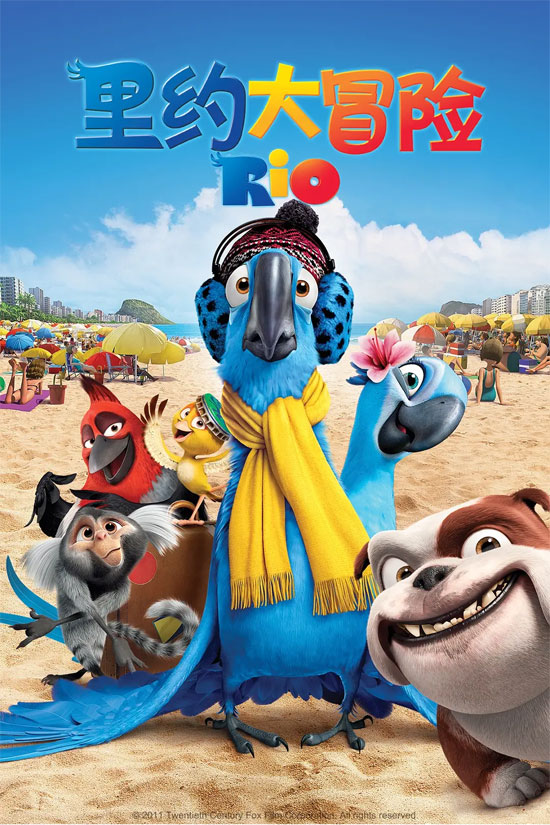
I’ve been pondering this question: If you strip away the dazzling bird spectacle and the vibrant Brazilian flair from the film “Rio,” what remains? My answer is the protagonist’s transformation from indulging in pampering to learning to care for others.
At first, Blu loved his life of reading newspapers in his cage, sipping cotton candy-infused chocolate milk while being waited on, and cuddling with his owner Linda to bask in endless pampering. Even when confronted by the provocations of free-flying peers beyond the glass, he rationalizes his existence with a touch of self-deception. His classic retort is that he lives under the protection of a modern technological glass enclosure (implied: wild birds could never enjoy such treatment), dismissing those outside as uncultured, uneducated, and uncouth “lowbrow” types. Blue couldn’t fly, but it saw no issue with this. Under its owner’s devoted care, it had no need for wings. Here too, it adopted an A-Q mentality, often consoling itself with the thought that many birds in the world couldn’t fly either.
Yet this pampering clearly failed to provide Blue with a truly safe environment. Adventure was destined to become part of his life. During this journey, when he discovered the glass no longer offered protection, his owner’s concern lagged behind like that slow-moving float, and the cage ceased to be a source of comfort, he learned a profound truth: true protection doesn’t come from being doted on by others, but from having a heart that cares for others.
Admittedly, it had cared for its owner before, but only to win more affection. One could say those who are overly pampered are inherently selfish, incapable of genuine concern for others. Upon arriving in Rio, when all its former protections proved useless, it was utterly lost. Initially, it disliked the opposite sex because they offered no sense of security. Its mind was still consumed with how to protect itself, not with caring for or helping others. What changed it? It was the native birds of Rio, who selflessly extended a helping hand to Blu. Their mutual compassion transformed Blu’s way of thinking.
Like other outstanding American animated films, this movie features a pivotal moment that serves as its emotional anchor. If the pivotal moment in “How to Train Your Dragon” is when Hiccup’s fingertip touches the fierce Night Fury’s snout, then the pivotal moment in “Rio” is when the cold physical chain binding Blu and Jewel breaks. The stark contrast in their behavior delivers a profound emotional jolt to Blu. When Blu could only stand rooted to the ground while Jewel soared freely through the sky, he realized that despite sharing the same species, they inhabited entirely different worlds. Only then did Blu truly grasp that his inability to fly was a profound shame—a failure that rendered his entire “life” incomplete.
If the film’s central focus lies in portraying the love story between two beings of the same kind yet from vastly different backgrounds and with contrasting temperaments, then what I anticipated most was the complete shattering of Blue’s dreams of life beyond his glass enclosure. And this very weight of expectation served as the final blow to shatter it. The film masterfully strikes the perfect balance here.
Ultimately, Blu learns the meaning of caring for others, forging a warm, heart-to-heart bond with Jewel—a chain of love that can never be broken, nor does it need to be.
Another exquisitely nuanced and thought-provoking portrayal in “Rio” is the act of flight. Far from being merely a physical movement for birds, flight here becomes a symbolic presence, embodying the authentic state of freedom in nature. What Blu loses is precisely this state, and what he must reclaim is this very essence.
The film’s clear celebration of nature, freedom, and authenticity is evident in its opening and closing sequences, which depict a carnival-like song-and-dance celebration of Rio’s jungle birds. As mentioned earlier, flight plays a decisive role in Blu’s transformation—from his initial disdain for the ability to fly to his loss of self-identity when he can no longer fly. This reveals that it was the longing for nature, freedom, and authenticity buried deep within Blu that spurred his transformation. It’s a profound metaphor. Did you notice the recurring flashbacks of Blu falling from a tree as a chick during his flight training? That was his true self calling out from within.
Like “Smallville,” the protagonist ultimately masters flight. The difference lies in the symbolism: in “Smallville,” Clark Kent’s mastery of flight signifies graduation—he completes all skills required of Superman, reaching maturity. In “Rio,” Blu’s mastery of flight isn’t an achievement but a return to his authentic self. The film aims to guide him from a psychologically unstable state caused by excessive pampering back to a normal psychological state that understands compassion.
This film stands as another outstanding work in bird characterization following “Legend of the Guardians.” Pay special attention to its depiction of avian wings—it avoids Disney-esque anthropomorphized designs (where bird wings resemble hands capable of grasping, picking up, pointing, and hugging) and instead prioritizes their fundamental function: flight. This approach underscores flight’s central importance in the film, directing attention toward the act itself rather than gimmicky anthropomorphic gestures.
Additionally, the film’s Brazilian-inspired score is quite splendid, and its depiction of carnival’s grand spectacle is breathtaking. Yet these elements ultimately serve as the film’s outer layer.