Film Name: 时空奇旅 / Arco
Last night I watched the newly released French sci-fi animation “Arco.” It’s not a long film, and the story and setting are quite simple, with echoes of many classic works, but I still enjoyed it quite a bit.
It’s a rare film that tells its story entirely from a child’s perspective (distinct from works that “appear childlike but are still guided by adult thinking”). While watching, I found myself instinctively comparing it to my own state of mind, and couldn’t help but feel a strange yet warm sense of how much I’ve aged.
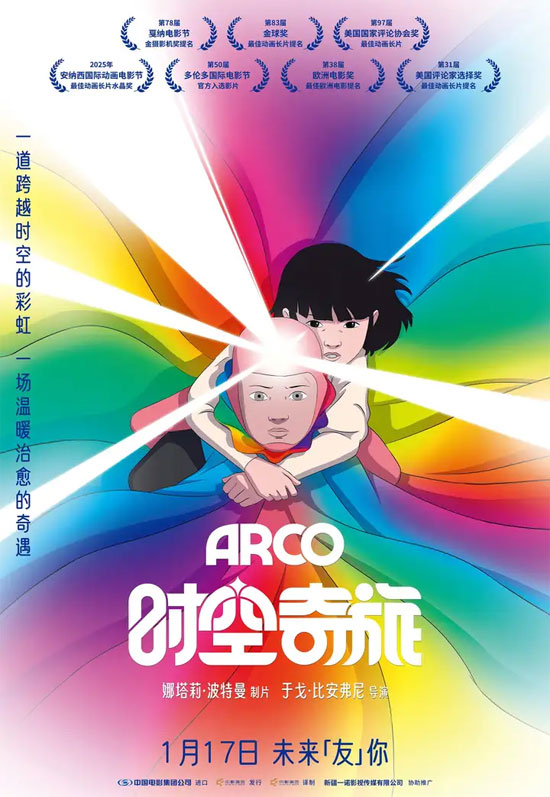
Though “Arco” primarily explores childhood growth, parent-child bonds, and worldview formation through a child’s lens, its sci-fi backdrop holds its own. The film offers numerous understated yet intriguing glimpses of the future, providing thoughtful viewers ample room for rich imagination and wild speculation.
A film this straightforward and innocent, with little to fault, is undoubtedly a good one.
[Spoiler Alert: The following contains plot details.]
“Arco” tells the story of two children from different eras meeting in the same space-time: In 2932, ten-year-old Arco secretly dons a Rainbow Space Suit for his first time-travel journey, only to crash-land in 2075. Alice, a girl his age, witnesses his fall and resolves to help the “Rainbow Child” return home.
Both children’s encounters stem from their restlessness—Arco defies the “no travel under 12” rule to see real dinosaurs, while Alice skips school to paint outdoors, escaping the monotony of her peers, and witnesses Arco’s rainbow descent.
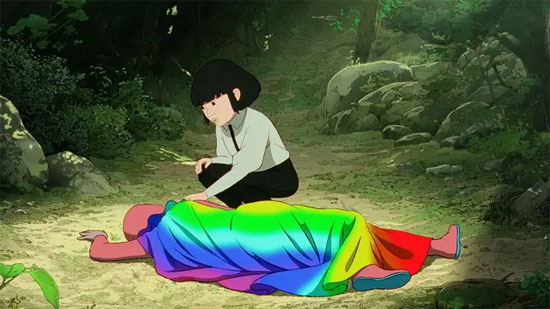
From an adult perspective, one might grumble inwardly, “Here we go again with the classic teenage trouble-making trope.” Yet “Arco” avoids any overt judgment—positive or negative—simply chronicling events as if they were utterly ordinary.
This is how children navigate the world. They may grasp some concepts of right and wrong, but not deeply, and they certainly don’t weigh values. They simply act on impulse.
This trait also surfaces in Alice’s instinctive wariness toward adults. When she spots three peculiar grown-ups searching the woods for the “rainbow,” she deliberately misleads them and secretly rescues Arco.
Incidentally, the “Red, Yellow, and Blue Trio” is the biggest red herring in Arco. Not only are they not villains (this film lacks true antagonists), but they are actually dream-chasing youths who’ve spent over two decades searching for “rainbow traces” to prove their childhood visions were real—adults whose perspective aligns with the two protagonists.
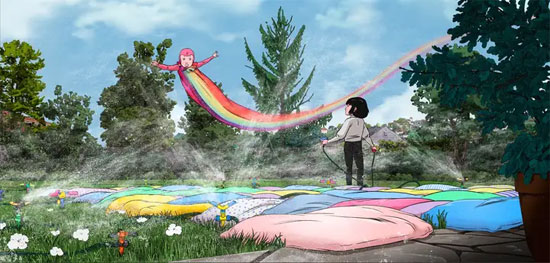
After Alice and Alco began communicating, neither had any clear “purpose”—or rather, their goals stemmed entirely from intense curiosity. Alco was fascinated by the rationing system and robot governance of 2075, while Alice wondered how to speak bird language and what kind of houses people lived in back then… Once their curiosity was somewhat satisfied, the two began working on Alco’s return home.
Incidentally, Arco initially intended to uphold the principle that “time travelers must not reveal the future.” But Alice’s relentless questioning soon broke his resolve. She tried to keep this little secret, but realizing she couldn’t manage it alone, she eventually told her parents—their reaction to keeping the secret was both authentic and endearing.
This brings us to a crucial theme in Arco: the parent-child relationship through a child’s eyes.
The film candidly portrays a child’s confusion about adults and societal rules, emphasizing their stubborn pursuit of personal beliefs. Even when such “immature words and actions” lead to bigger troubles and consequences, it maintains the utmost understanding, tolerance, and even admiration.
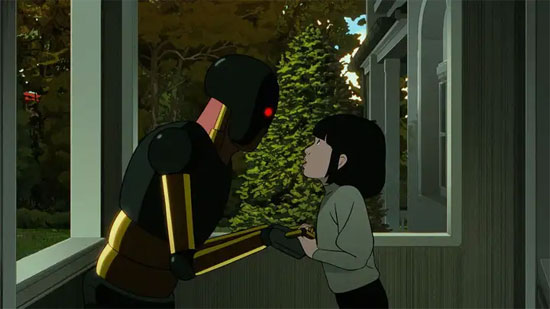
Take Alice’s attitude toward her parents: she undoubtedly loves them, but they spend all day working outside the home, offering only symbolic companionship through holographic projections during dinner and bedtime. Their refusal to lower their guard and truly engage with her inevitably leads Alice to question the nature of their familial bond.
This is why Alice ultimately helps Arco to the very end, pleading for him to take her along. At the critical moment, she suddenly realizes that Mickey, the robot nanny who has always been by her side, is the one who truly embodies the emotional projection of parental love in her heart…
What’s even more remarkable is that while “Arco” expresses a child’s questioning and resistance toward family bonds, these emotions aren’t sharp or presented as an all-or-nothing dilemma. It still holds onto hope and belief in love’s existence—Arco’s parents and sister found him “decades later,” and Arco’s wish to return home was fulfilled. This outcome also prevented Alice from leaving her parents with any real regrets.
This is the world through a child’s eyes: imperfect, yet dotted with fleeting wonders and sudden flashes of hope.
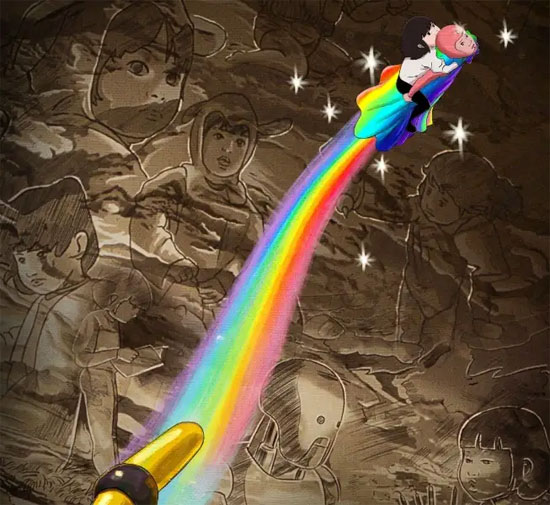
Finally, a brief note on the sci-fi elements in “Arco.” Though not heavily emphasized, they form a coherent system.
For instance, the film adheres to the principle that “technology advances relentlessly, yet human survival grows increasingly precarious.” By 2075, life is convenient but severely restricted in mobility, with little defense against natural disasters. This is followed by the “Great Fallow,” leading to 2932 where humanity survives only in “sky tree houses.” Basic necessities are secured, but the reliance on retrieving plants from past eras for cultivation relying on plants retrieved from past eras for cultivation” underscores how the sense of imbalance from 2075 has intensified.
The root cause of this outcome, I believe, lies in humanity’s blind faith in technology and its own arrogance. One telling detail illustrates this: by 2075, schools employ robotic teachers in holographic classrooms, while traditional libraries have become “places absolutely no one visits.”
Additionally, as a work incorporating time-travel elements, “Arco” delivers: Before Mickey’s complete shutdown, he painted a mural depicting Alice’s life story. Arco’s family used this mural to find their way to this era, while Alice, guided by Arco’s descriptions, sketched blueprints for future homes. As she grew up and pursued her research, these sketches became the prototype for the aerial treehouses—thus completing the closed loop of mutual influence between the two timelines.