Film Name: 极限审判 / Mercy
This weekend’s new release, “Mercy,” may disrupt the long-standing dominance of several older films in January’s box office rankings.
This is a polished Hollywood commercial film—fast-paced, with fresh themes, multiple plot twists, and a solid conclusion. Though its core narrative remains familiar—questioning advanced technology and established authority while championing individual heroism—and lacks groundbreaking innovation elsewhere, it delivers pure entertainment. As a satisfyingly thrilling spectacle, it hits the mark.
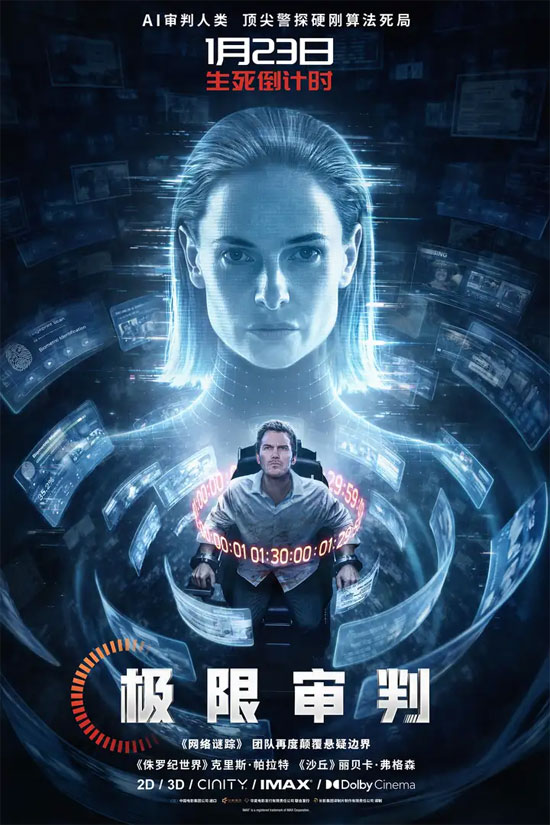
“Mercy” is a quintessential desk-bound film, crafted by the team behind “Searching.” Visually, it resembles a “Minority Report” where the precogs are replaced by an AI judge.
Set in a near-future Los Angeles grappling with skyrocketing crime rates and inefficient law enforcement, the AI judicial system Maddox—assumed to handle the roles of judge, jury, and executioner—begins its controversial operation. Detective Chris Raven becomes Judge Maddox’s 19th defendant. Overwhelming evidence points to him murdering his wife Nicole. Granted access to all available data, Raven must prove his innocence within 90 minutes or face execution in the courtroom.
“Mercy” pours old wine into a trendy new bottle of AI technology, with many plot devices best left unexamined—like expecting the prime suspect to dramatically clear his name within 90 minutes, which is practically equivalent to a death sentence… Yet as a classic suspense setup, it undeniably succeeds.
The film cleverly employs breakneck pacing to drive the narrative forward. After introducing a premise, concept, or revelation, it swiftly plunges into corresponding plot developments—using individual points to illuminate broader contexts, then using those contexts to reveal further layers. The film’s runtime mirrors the trial’s duration, ensuring audiences have little mental bandwidth left for overthinking the plot. This immersion strategy keeps viewers fully engrossed in the unfolding story.

It must be said that the narrative strategy employed in “Mercy” proves effective. It successfully breathes life and tension into a story that isn’t inherently fresh or particularly intriguing. For instance, Chris’s emotional fluctuations during the investigation and the reuse of certain clues amplify their impact and satisfaction within the corresponding pacing and atmosphere.
Even the film’s numerous predictable plot twists—which aren’t particularly hard to anticipate—avoid alienating audiences thanks to this refreshingly straightforward approach of “delivering the information without gloating.” If it doesn’t detract from the experience, it actually adds to it.
I won’t delve into specific plot details—there’s little to discuss here. Interested viewers should experience it for themselves.
Finally, a brief note on Mercy’s stance toward contemporary American society and AI applications: though its exploration remains superficial for a commercial action flick, it still touches on some noteworthy themes.
Judge Maddox is portrayed as an advanced AI “capable of making no mistakes,” yet it remains susceptible to misjudgments. This vulnerability stems from its reliance on human-provided clues and evidence. If someone deliberately withholds critical evidence or “contaminates” the data with false information, the AI’s analysis becomes inaccurate.

As long as human involvement remains in the use of technological tools, the risk of error persists. As for AI that operates entirely independently of human data—well, that’s not within the film’s scope…
By the way, Rebecca Ferguson is stunning, but likely due to deliberate makeup choices and lighting, combined with her consistently “ice queen” expression in the film, Judge Maddox often comes across as sinister and cold—which fits perfectly.
Because Officer Jacqueline concealed crucial evidence, the AI judge’s first verdict after activation was flawed. This miscarriage of justice sets the film’s plot in motion—her motive? Simply ensuring Judge Maddox could turn the inaugural case into an ironclad conviction.
After all, David, a homeless man with a history of drug use, seemed beyond redemption anyway. He, the murder victim, and the real killer were all scum of society. What difference did the truth make? Better to help the AI court system roll out smoothly and make a real contribution.
The problem is, Jacqueline’s actions seem somewhat justified within the film’s context. Coupled with the current heated debate over the “kill switch” in the U.S., it’s undeniably a darkly humorous reflection of reality.