Film Name: 我的朋友安德烈 / My Friend An Delie
Coincidentally, last weekend saw the release of another film adapted from Shuang Xuetao’s novel and set in old Northeast China, alongside “Take Off.” That film is “My Friend An Delie” (hereafter referred to as “An Delie”).
The film possesses a commendable aesthetic quality—a blend of crispness and warmth, restraint and relief. Its cinematography, scenes, and performances all merit praise. While it occasionally feels more concerned with style than substance, with narrative flourishes overshadowing deeper storytelling, Dong Zijian’s debut directorial effort still deserves recognition for reaching this level of accomplishment.

Counterintuitively, while my overall impression of “An Delie” is quite positive, upon closer examination, I find myself more inclined to discuss its shortcomings, regrets, and areas for improvement.
I won’t delve into how the film adapts the original work here; I’ll focus solely on the film’s own execution.
What disappoints me most is the film’s failure to fully leverage its historical setting. The core motif of “loss”—central to contemporary Northeast Chinese literature and cinema—feels underdeveloped here (not entirely absent, but merely a superficial backdrop). The narrative focus remains almost exclusively on Li Mo and Andre… In other words, this story could unfold anywhere.
Of course, the notion that “a story set in a specific place must be filmed in a certain way” is somewhat dogmatic and narrow-minded. But when “An Delie” captures scenes like old-fashioned schools, dilapidated factories, gray row houses, and quiet snowfields with such precision, only to use them as atmospheric elements that contribute little to the narrative, it still feels like a waste.
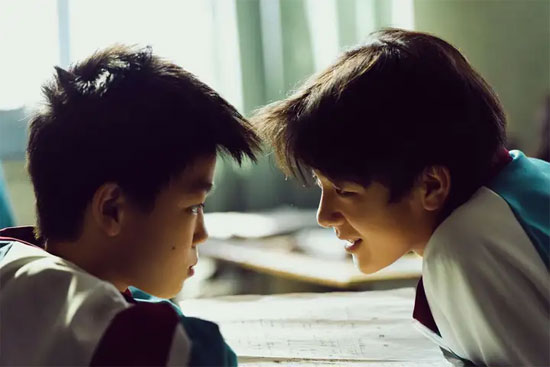
At the same time, “An Delie” leans heavily into technical showmanship in its cinematography and storytelling. While visually impressive, it sometimes distracts from the narrative.
For instance, when André’s parents are summoned after he publicly reports his teacher for Li Mo, the film doesn’t directly show the six people—the principal, teachers, child, and father—in the same room. Instead, it uses moving shots to capture their reflections through glass. Similarly, scenes in the bathhouse and noodle shop repeatedly use reflections and silhouettes to convey characters’ seemingly clear yet hazy states.
It’s not that employing these techniques is wrong, but great works should make such methods “harder to notice” and appear more “natural”—which likely requires true mastery.
Similarly, the film’s dual narrative structure, which deconstructs and reassembles the protagonists’ childhood and adult storylines, feels somewhat unnecessary to me—or at least underdelivers on its intended effect. Fortunately, the story content and the actors’ performances remain solid.
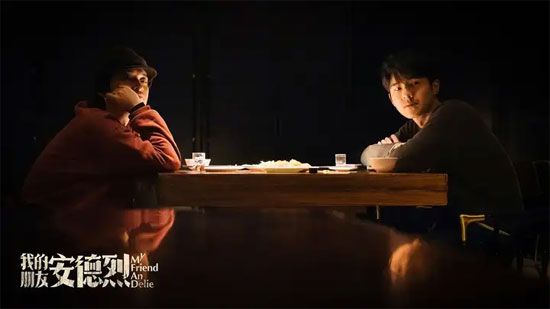
One final point: An Delie’s watchability relies too heavily on its central twist. Dong Zijian likely recognized this, which is why the scene where Li Mo enters the hotel restaurant hints so obviously that “Andre doesn’t exist.”
The problem is that revealing this twist too early or too late would have been equally problematic. Much of the middle and latter parts of the film revolve around the question “Where did An Delie go?”, which ends up feeling like the film is being held hostage by this clever idea. This, in turn, exposes the film’s lack of other compelling elements.
While the above nitpicking may seem harsh for My Friend An Delie, it stems largely from my appreciation for the film: it captures a moving friendship within a decaying yet luminous world, burying that memory by healing the protagonist Li Mo’s emotional wounds. It’s a tale of tragic beauty and sorrowful elegance—one that could have been even more exceptional.