Film Name: 老夫子之小水虎传奇 / Old Master Q and Little Ocean Tiger
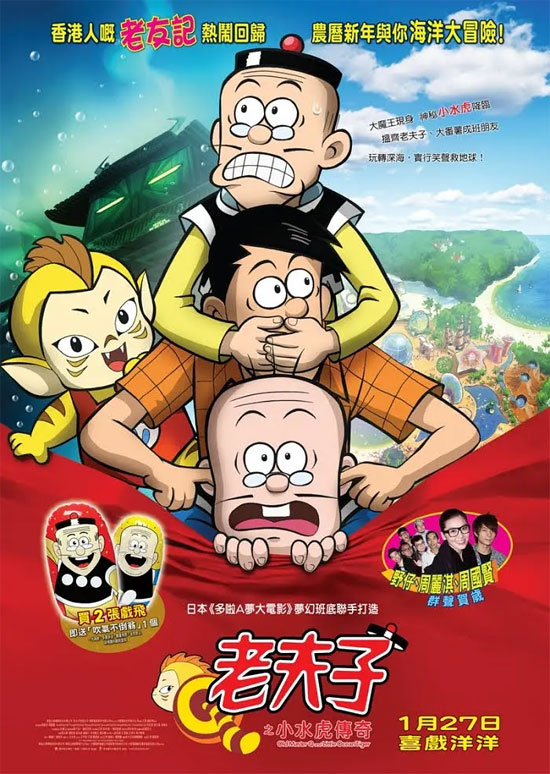
The charm of the “Old Master Q” comic lies in its portrayal of the everyday lives of ordinary people. Though called “Master Q,” he is no great figure but rather an everyday person found anywhere in life. He’s a bit of a womanizer, somewhat greedy, loyal to friends, and deeply devoted to love…
Like Sanmao, Old Master Q is a comic character born in that unique era of the last century when China was in turmoil and its people suffered greatly from war. While contemporary comics often glorify heroes and exceptional talents, cartoons of that era particularly favored depicting ordinary people in everyday life—with Sanmao representing a child’s perspective and Old Master Q embodying an adult’s view. Zhang Leping analyzed society through Sanmao’s childlike lens, while Peng Di observed the world through Old Master Q’s mature eyes. Later, Old Master Q was brought to Hong Kong by cartoonist Wang Ze (pen name) and became a cartoon icon beloved throughout the Chinese-speaking world.
I’ve always believed that characters like Old Master Q hold far greater significance in short comic strips than in feature-length films. This character functions like a window—through him, we glimpse the myriad facets of human existence, not just a single static image. His role as a descriptive chronicler of social development holds greater importance than the artistic value of his works themselves. Yet in a feature-length narrative film, it’s difficult to grasp this sense of history. Indeed, if heroes are like a juicy cut of meat—meant for the big screen, satisfying in one hearty bite—then ordinary folk are like a bowl of sunflower seeds. Their flavor unfolds only through continuous, repeated nibbling; it’s hard to imagine savoring anything from just one seed.
Of course, if directors and producers insist on transforming “Old Master Q” from an ordinary character into a hero, it’s not impossible. Ordinary people can become heroes, but such films must clearly depict one crucial thing: what heroic qualities this ordinary character possesses. But if a film already features a hero—like the South Sea Dragon King in this film, who is handsome, powerful, and morally upright—then it must be made clear what the ordinary character possesses that this hero lacks. Only then can he make the leap from ordinary person to hero, surpassing the film’s apparent hero. Unfortunately, in this film, we find nothing in Old Master Q that surpasses the South Sea Dragon King. This leaves one crucial question unanswered: If the Dragon King could resolve every issue single-handedly, why was Master Lao’s involvement necessary? What essential purpose did he serve in this film? If he wasn’t indispensable, then casting Master Lao as the protagonist fundamentally undermines the film’s premise.
This is the most fundamental question of the film. Another question is: what exactly ignited the latent potential within Little Water Tiger?
As we discussed in our review of “CJ7: The Cartoon,” when otherworldly pets enter their advanced state, it must be triggered by a spiritual impulse. This spirit is 90% fueled by love—or rather, a protective instinct toward cherished things. Little Water Tiger should be no exception. It absolutely should not have activated this power on its own, as that would strip away crucial depth. The film must first establish Little Water Tiger’s love and protective instincts toward Old Master Q and the others, then place them in a desperate situation before triggering its awakening. Yet this film neither convincingly builds such protective bonds nor plunges the characters into ultimate peril. Instead, Little Water Tiger inexplicably ascends to its advanced state—a clear lack of depth.
These two issues could actually be resolved together. For instance—purely hypothetical—we could have a scene where, as Fire King directs flames toward the suspended Little Water Tiger, the mortal Mr. Qin, Big Sweet Potato, and Old Master Fu step forward one after another, using their own bodies to block the flames. Old Master Fu might even be burned to the point of near-death. At this moment, the Little Water Tiger unleashing its full potential becomes entirely plausible. For love is reciprocal—it was moved by Master Old Man’s self-sacrificing love to save it, thereby awakening its latent power. And Master Old Man, through this act of courage, surpassed the Dragon King of the South Sea in a single stroke. For though the Dragon King of the South Sea possessed formidable abilities and commendable virtue, he ultimately viewed Little Water Tiger merely as a tool to thwart the Flaming King’s world domination—never truly cherishing this young life from the heart. Old Master, however, along with these ordinary mortals, genuinely regarded Little Water Tiger as family—family worth sacrificing their lives to protect. In this respect alone, he had already surpassed the Dragon King.
Another noteworthy aspect of this film is its traditional hand-drawn animation style. Amidst the barrage of American 3D blockbusters and the increasing prevalence of Flash-style fast-food animations like Pleasant Goat on television, traditional 2D animation has become increasingly rare. From the very first frame, the film immerses viewers in the long-lost charm of traditional animation. While some might find it unremarkable, for me, it truly sparked a little happiness.