Film Name: 阿凡达:火与烬 / Avatar: Fire and Ash
The final blockbuster of the year, “Avatar: Fire and Ash” (hereafter referred to as “Avatar 3”), has arrived!
After catching the preview screening last night, I was thoroughly entertained. Now, half a day later, I’ll try to share my thoughts as objectively as possible: Subjectively, I enjoyed this film. But objectively speaking, it didn’t deliver the same level of awe and surprise as the first two “Avatar” movies. The third installment feels more like a synthesis of the first two films—both its strengths and weaknesses can be traced back to its predecessors.

To be more specific: “Avatar 1” + “Avatar 2” = “Avatar 3.” The third installment forms a cohesive whole with the second (effectively concluding “The Way of Water” storyline) while heavily borrowing the framework of the first. Both in plot and technical execution, it offers little that feels genuinely new.
Yet this “lack of novelty” is only relative within the Avatar franchise. When viewed within the broader context of Hollywood blockbusters or global commercial cinema, it remains in a league of its own.
Moreover, compared to the relatively straightforward themes of “colonization versus anti-colonization” and “preserving ecological balance and family” in the first two films, “Avatar 3” delves deeper into the more complex and weighty topic of “coexistence.”
[Spoiler Alert: The following contains plot details.]
Many viewers come to the Avatar series for its visuals and special effects, and my biggest disappointment with Avatar 3 is that it fails to deliver the revolutionary breakthroughs seen in its predecessors.
Whether it was the first film’s pioneering use of full 3D simulation that briefly brought 3D cinema back into the mainstream, or the second film’s underwater cinematography that produced stunningly realistic visuals—both achievements remain topics I can discuss enthusiastically for a long time… From this perspective, “Avatar 3” feels stagnant.
While technical innovation is far harder than narrative innovation, this is Cameron’s “Avatar” franchise we’re talking about. If it were anyone else’s film, I wouldn’t have these complaints.
Even so, “Avatar 3” still boasts some genuinely eye-catching designs, scenes, and visuals. Here are three examples:
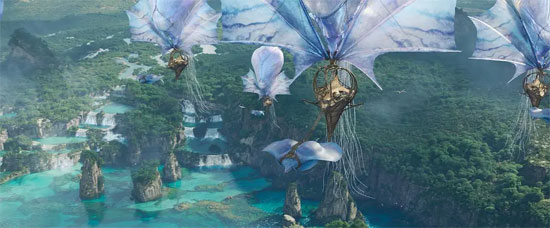
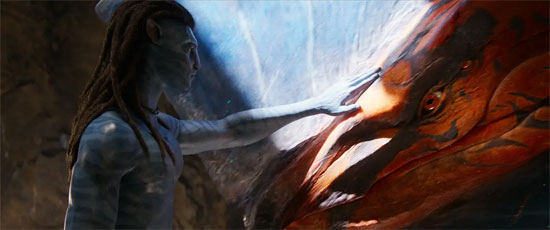
One is the Sky Tribe-like Wind Travelers caravan. Their appearance further enriches Pandora’s world-building (a neutral merchant guild), and their “mounts” are among the film’s most inventive designs.
I don’t know what these creatures are called—they resemble jellyfish, balloons, manta rays, and butterflies all at once—yet they miraculously blend so many biological and mechanical traits. Moving slowly and gracefully, they appear beautiful yet clumsy and fragile.
Another standout moment is when Neytiri infiltrates the human city to rescue Jake, riding a Banxi beast as she dashes through the steel jungle.
Perhaps because “Na’vi activities are often tightly bound to Pandora’s natural landscapes,” the sight of this heroic female rider navigating battles among human structures feels entirely different—a freshness born from the fusion of disparate elements.
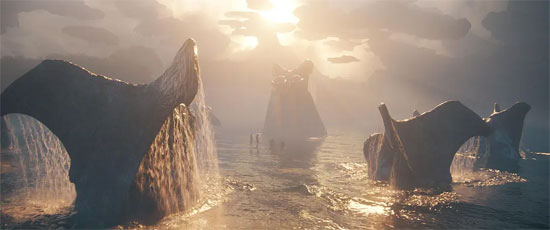
The final scene is the awe-inspiring spectacle of the T’Kune clan revealing their full might and spearheading the assault against the human army.
Turns out, the T’ulim sequences in The Way of Water were just a warm-up. Avatar 3 delivers the true spectacle—especially the colossal size of the elder T’ulim, adorned with intricate patterns and decorations that transcend ordinary beauty. When these giants breach the surface to smash the human ” whaling ships,” I felt a long-forgotten rush of visceral excitement.
Any one of these highlights could be touted as a major selling point in other blockbusters… Yet with such high standards set by its predecessors, “Avatar 3” merely refines and expands upon its legacy—quantitative evolution without qualitative breakthrough.
Thus, my verdict on its visual effects: still world-class in its own right, but by its own standards, it’s not quite as impressive anymore.
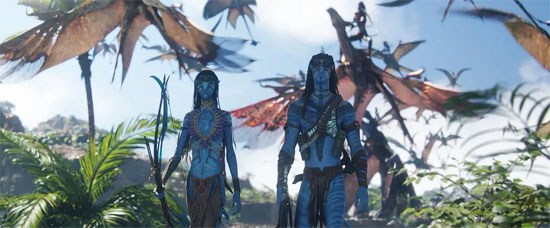
Moreover, the narrative of “Avatar 3” similarly fails to break free from the formula of its predecessors, with several pivotal plot points still relying on the “family members kidnapped/threatened” trope to drive the story forward (this time, the “prized catch” is a spider). It’s likely this installment will draw just as much criticism and ridicule as “The Way of Water.”
The climactic battle sequence, in particular, feels like a direct amalgamation of the final showdowns from the first two films: Jake Sully once again rallies the Na’vi tribes under the name “Turuq Makdo,” the battlefield is the sacred grounds of Tunkun, and the pacing follows the same pattern of building tension before a climactic release. Even the later appearance of Eywa mirrors the original—only this time, instead of a combined aerial and land assault from the first film, we get a marine and aerial force joining the fight.
While I still enjoyed it, I understand why many viewers are frustrated by such blatant repetition. The film is already lengthy, and much of it focuses on mundane family drama and tired tropes—it’s no wonder some feel fatigued.
Having vented my frustrations, let’s now discuss the noteworthy aspects of Avatar 3. The film’s most innovative creation is the newly introduced Na’vi tribe, the “Fireclans” / Ash People, who embody the “fire and ash” referenced in the subtitle.
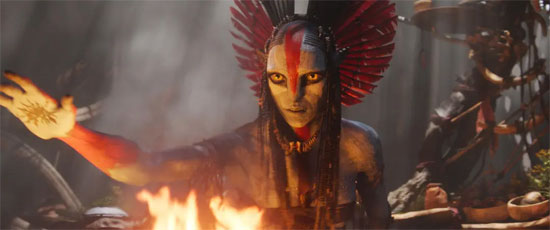
The Ash People’s High Priestess Valonque is a profoundly underrated character. Her role extends far beyond “leading her tribe to sever ties with Eywa.” Her true significance lies in establishing an independent faction and challenging Eywa’s authority.
After their homeland was destroyed by a volcano, Valang abandoned the Na’vi’s traditional beliefs and instead revered the flames symbolizing destruction. Why do the Ash People appear more combat-ready than other Na’vi tribes? Because they’ve discarded the unreliable worship of the Eywa and embraced the self-reliance of “man conquers nature.”
Upon witnessing the power of human firearms, Valang immediately sought to master them. Compared to other semi-civilized tribes (who passively encountered humans), the Ash People—who actively embraced “advanced technological civilization”—clearly align more closely with our conventional notion of “modern humans.”
Her singular independence, her desire to consume everything, coupled with mind-bending witchcraft, made Walan’s psychic power exceptionally potent. Using “neural connection,” she could nearly crush all the Na’vi—her actions essentially amounted to creating a new Avatar from scratch.
Of course, Valang’s power remains far weaker than Eeva’s. Yet once the seed of her “reset” takes root and grows, the ebb and flow of power may eventually lead to Eeva’s replacement and extinction. This is an inescapable conflict of paths for Pandora, compelling her to act decisively.
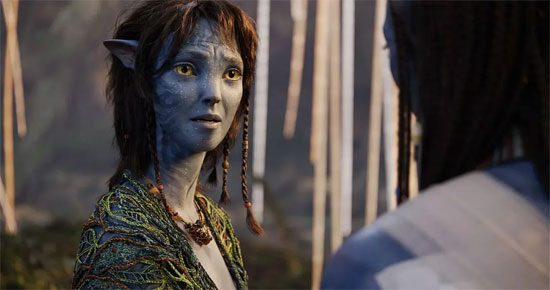
Judging by the giant face of the Avatar that Kiri and the others witnessed, even if the Avatar did not evolve from ancient Na’vi, it at least possessed a distinct, autonomous consciousness.
Truth be told, the goddess Eywa proved far more adaptable than the Na’vi who worshipped her. She understood the Na’vi could never match humans, nor withstand the alien Scourge in the long run. Relying on them to preserve her legacy was futile—better to harness an outsider as a catalyst while personally orchestrating the process.
Thus, in the first film, Eywa accepted Jack Sully as both a Na’vi and a Ghost Rider. In the second, she used Dr. Grace Augustine’s Avatar to give birth to the spokesperson Kiri (whose mental potential and power, if the “signal” remained stable, would far surpass those of Valon). By the third film, she had even begun accepting human spiders as part of her own kind.
Upon reflection, the Na’vi—these indigenous people—were nothing more than lambs led to slaughter before the human colonizers. Even when they fought back, it amounted to little more than disorganized, instinctive reactions. In truth, most tribes were like the T’kune: they wouldn’t retaliate even when humans were at their throats.
Jack was the seed of resistance planted among the Na’vi by Eva. His dual identity as a Marine and Tl’uk Makdo enabled him to effectively organize and mobilize the Na’vi. As the Sully family grew, a young, militant faction finally emerged within the Na’vi tribe.
Sustaining a protracted struggle requires more than one generation. It was precisely because the incorrigible Lo’ak insisted on maintaining his brotherhood with the Na’vi outcast Pajakan that he influenced peers like Tera and Onon, emboldening them to voice dissent against their elders. This shift allowed the Na’vi’s anti-colonial resistance to gain momentum.
This leads to the core theme of “Avatar 3”: What path should Pandora’s future take? Especially when the Na’vi cannot expel humans and humans cannot exterminate the Na’vi, what form of coexistence should be pursued, and who should lead it?
The film presents its first answer: a new Pandora model led by humans and the Ash People.
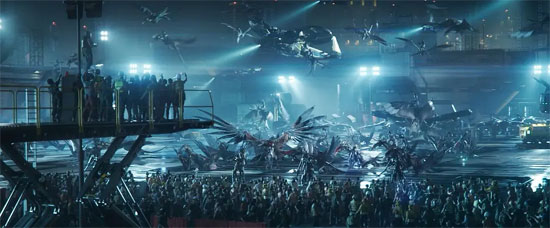
Truthfully, Colonel Quaritch’s alliance with the Ash People and his decision to bring them into human cities was a politically brilliant move (far more astute than the generals who rejected all Na’vi). This demonstrated to all human colonists a stance of ” We are not evil invaders; we have indigenous allies.” This stance powerfully alleviates humanity’s moral burden, significantly boosting the efficiency of Pandora’s development and transformation.
Don’t underestimate that moral burden. Few individuals willingly admit to doing wrong, and a whole group certainly won’t (even the Puritans found pious justifications for killing Native Americans). If this issue isn’t handled properly, traitors like Grace, Norman, Jack. Take marine biologist Dr. Ian, for instance: he could hypocritically tolerate humans hunting Pandora’s whales one by one, yet when faced with mass slaughter, his defenses crumbled and he turned traitor.
For the Ash People, their original goal of eliminating Eywa and taking her place aligned perfectly with the destructive human colonists—a mutually beneficial alliance. Together, they possessed the power to truly reshape Pandora.
Interestingly, Quaritch actually heeded Jack’s advice to “open his eyes to the world.” Only, what he saw wasn’t the nature embodied by Eywa, but the destruction-worshipping Valon. By the film’s end, Quaritch—stripped of his uniform and painted in red-gray camouflage—had effectively converted to the Ash People’s faith. Like Jack, the Colonel became a paragon of racial integration.
Another answer, naturally, is the traditional Pandora model led by Eywa and the Na’vi.
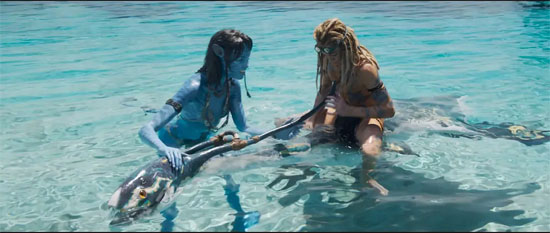
Realizing indigenous forces cannot stem humanity’s iron tide, Eywa maintains resistance while seeking harmony between old and new races. Her boldest experiment in Avatar 3 involves modifying a spider’s body, creating the first human capable of breathing freely on Pandora and connecting with all life.
(A similar shift can be seen in Neytiri, who long viewed human weapons as poison, relying solely on ancestral bows and arrows. After adopting Jack’s handmade explosive darts, she discovered the “powerful” arrows’ appeal.)
While ordinary humans may struggle to meet the Na’vi’s strict assimilation criteria, this development undoubtedly sends a positive signal to both the Na’vi and humanity. It introduces a third option—harmony—between the stark choices of “war” and “surrender.”
Ultimately, these two paths represent the pragmatic route and the idealistic route. The “Avatar” series clearly favors the latter.
This reminds me of the Sky Island arc in One Piece, where half of Gaia Island was carried skyward by the Sky Stream, sparking a protracted war between the Sky Islanders and the indigenous people over land. At a certain stage of the conflict, right and wrong ceased to be the paramount concern—the surviving factions had to forge a relatively peaceful path forward.
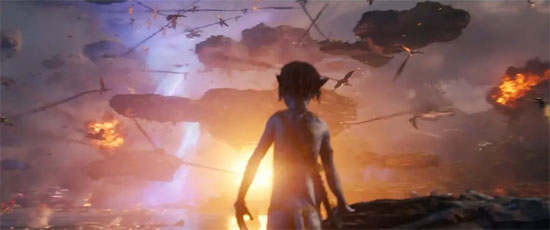
However, any harmonious and peaceful existence cannot be achieved through mere words. It must endure the baptism of blood and fire, along with the constant trial and error and sacrifices required—this is likely Pandora’s version of “Peace exists only through struggle.”
If there are future installments like “Avatar 4” and “Avatar 5,” I hope to see more stories explored at this profound level.