Film Name: 用武之地 / Escape From The Outland
Last night I caught the sneak preview of “Escape From The Outland.” After leaving the theater, I was eager to praise it, but several flaws soon came to mind. After some thought, I decided a cautious recommendation is in order.
Let me start with a simple conclusion: With almost no “genre advantage” to rely on, Ao Shen proves himself a truly talented director and writer through this film. His fundamentals are solid—he delivers gripping plots, excels at character development, and consistently shines in lyrical storytelling and thematic exploration… However, the film suffers from a “relatively weak” main narrative thread. While showcasing ample excellent material, Ao Shen sometimes loses focus, resulting in several forced plot elements. Consequently, though it’s a good film, it doesn’t deliver a fully satisfying viewing experience.
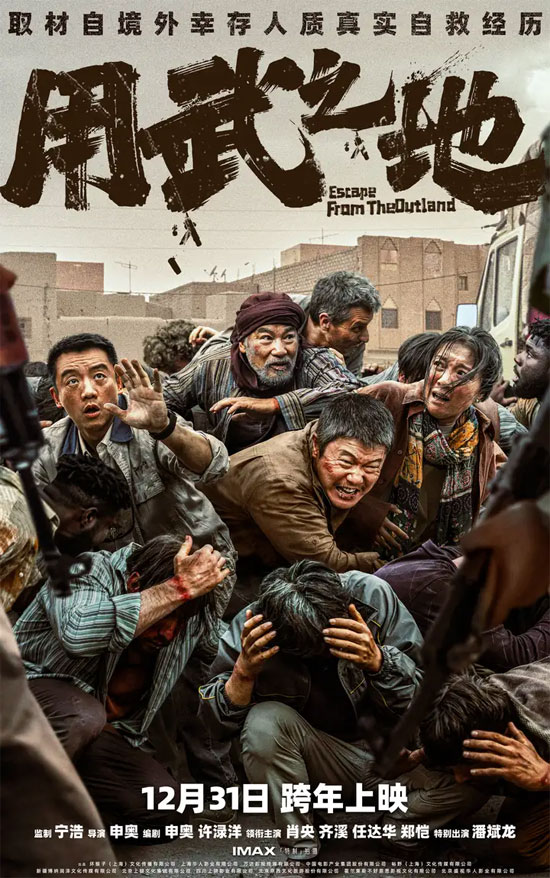
First, the strengths.
Regardless of its overall strengths and weaknesses, “Escape From The Outland” made an excellent first impression within its opening twenty to thirty minutes. It felt exceptionally smooth—from the sudden terrorist attack, to swiftly establishing the basic profiles and identities of characters like reporter Ma Xiao, doctor Pan Wenjia, and engineer Miao Feng, to the protagonists’ unexpected journey into the chaos zone. The pacing and direction were spot-on.
Simultaneously, the film introduces numerous abrupt twists and counterintuitive plot points, often catching both characters and viewers completely off guard.
For instance, the medical van is ambushed and hijacked while attempting a rescue; Miao Feng steps on a landmine just after finding gasoline; Ma Xiao merely seeks to buy fuel from a child in a neighboring village, only to be betrayed and endanger the very village that came to his aid…
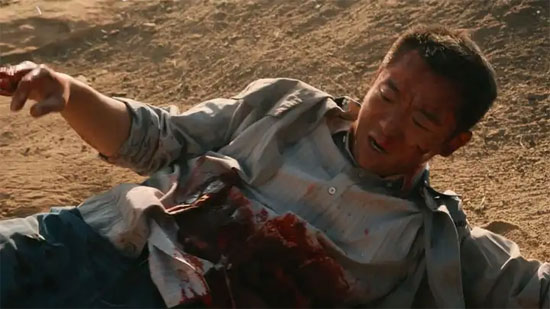
These unexpected yet plausible plot twists—where good intentions invariably lead to disastrous outcomes—gain an added layer of absurdity and cruelty against the backdrop of perpetual war and strife.
Incidentally, as modern warfare in the new century has become largely abstract for us Chinese, we rarely produce works in this genre. “Escape From The Outland” shifts the narrative stage, incorporating war elements and anti-war themes seldom seen in domestic films—
Unlike films like “Wolf Warriors 2,” “Operation Red Sea,” or “Home Coming,” this movie isn’t about evacuating citizens or rescuing hostages. Instead, it uses the perspectives of ordinary people to comprehensively depict the low-intensity, high-destruction reality of war and terrorism. It’s the kind of ” anti-war film” (no derogatory intent—why should the moral high ground of humanitarianism always belong to others? We have every right and reason to claim it).
With a bit more attention, you’ll notice numerous details woven into this thematic fabric.
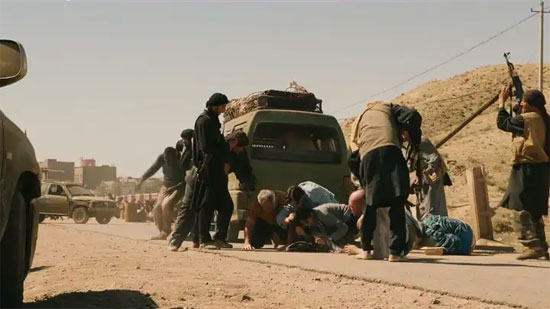
For instance, in the opening scene, an Italian scout arrives to scout promising talent. The deputy mayor uses every means possible to funnel a 14-year-old boy into the ascension pipeline—a component of the neo-colonial system. In the blink of an eye, that child becomes the first casualty of the Iron Army’s assassination operation.
Then there are the landmines scattered throughout the film, which not only narrate centuries of bloody conflict but also serve dual purposes—killing and saving. While these mines claim countless lives and limbs, their casings can be repurposed to grow tomatoes.
What struck me most about Escape From The Outland was its masterful characterization, with the supporting roles played by foreign actors often outshining the Chinese characters.
Take Sayed, the junior leader of the extremist terrorist group Iron Army. He clearly received higher education, knows how to use the latest action cameras, and prefers to kill with a single, clean pistol shot. When releasing a worthless Nepalese nurse, he spares her only to hand her over to the desert for execution—both to spare the other hostages’ feelings and for easier management. This is a modern individual who treats terrorism as a profession.
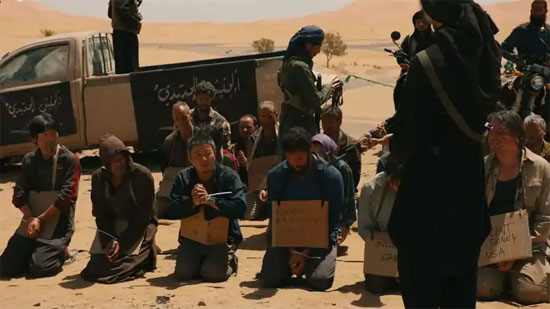
Yet when two soldiers escape capture, the enraged leader orders Saeed to personally hack off their feet. He nervously carries out this dirty work against his will.
Not only that, but to prove his devotion, Saeed later goes out of his way to target the couple Ma Xiao and Jia Jia. From a practically enlightened man, he regresses into a barbaric extremist.
The portrayal of Latif and Salim, father and son, is equally vivid. The former is a good man thwarted in his attempts to commit misdeeds amid chaos, later becoming friends with Ma Xiao. The latter is a child forced into becoming cannon fodder for the Iron Army—his conscience intact and yearning for freedom, his tragic fate culminating in being killed as a terrorist.
The boy later adopted by Latif also briefly served as a child soldier in the Iron Army. When he chooses to aid “Uncle Tomato” Ma Xiao over the Iron Army, he shines a light on humanity’s inherent goodness amidst a war that dehumanizes all.
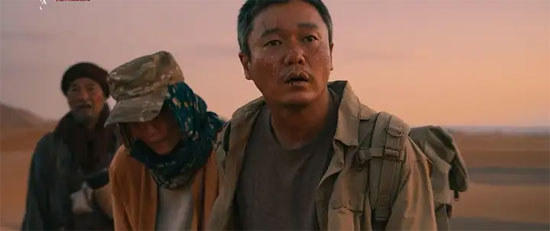
Given all its strengths, “Escape From The Outland” should be a compelling watch. Unfortunately, its overall storytelling falls short, most notably due to fragmented and disjointed character arcs that lack a cohesive narrative thread.
While Ma Xiao and his companions escaping to freedom is a logical core plot, in practice, both Miao Feng’s abrupt departure and Ma Xiao’s prolonged stay in Latif’s village contribute little to the main narrative. Even the subsequent twists and turns after Ma Xiao, Pan Wenjia, Zhou Weijie, and others become prisoners of the Iron Army feel scattered and lacking focus.
With such uneven pacing, the film inevitably resorts to forced plot devices and deus ex machina moments (like Jiajia narrowly surviving a drone strike just before being burned alive), which alienate many viewers.
Overall, however, I consider these minor flaws overshadowed by the film’s strengths. “Escape From The Outland” remains a work where the positives outweigh the negatives.
Finally, it’s worth noting that “Escape From The Outland” was made by Ao Shen before “Dead To Rights.” Over the years, I’ve witnessed his entire evolution from “My Dear Liar” to “No More Bets,” then to “Escape From The Outland,” and finally to “Dead To Rights.” Ao Shen has consistently grown as a filmmaker. Compared to the fleeting successes or failures of individual projects, this trajectory of growth is what makes him truly exciting to watch.