Film Name: 过家家 / Unexpected Family
After taking a few days off around New Year’s Eve, I finally made my first trip to the cinema last night to see this year’s opening film, “Unexpected Family.” I found myself tearing up several times during the screening…
Honestly, the film itself is at best a fairly standard family drama with comedic elements. However, Jackie Chan’s portrayal of Ren Jiqing, an elderly man suffering from Alzheimer’s disease, significantly elevates the film’s depth and emotional resonance.
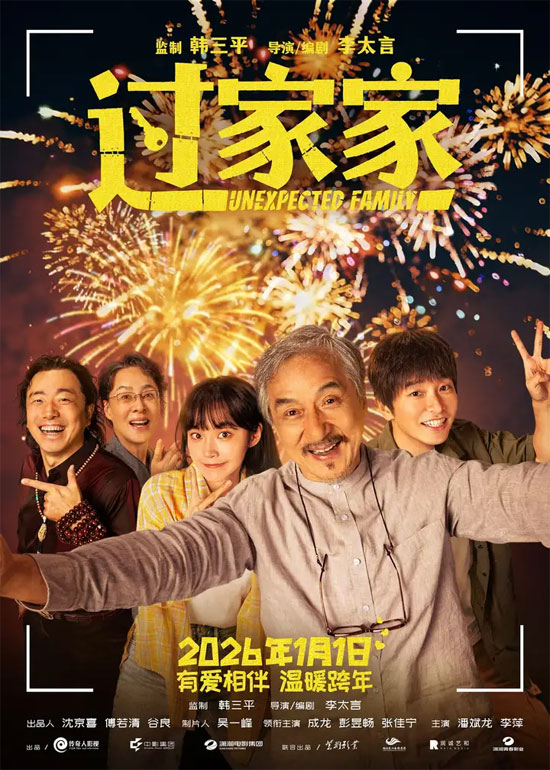
This assessment stems largely from Jackie Chan’s iconic on-screen persona in audiences’ minds—the indestructible, unbeatable fighter. Even in recent films like The Foreigner and The Shadow’s Edge, which briefly hinted at his aging, he still portrayed a formidable old warrior. This image persists even more strongly in his other mediocre films where he struggles to carry the story (not to mention the AI face-swap fiasco in A Legend). .
Precisely because Jackie’s on-screen persona is so deeply ingrained, when he completely abandons “action” and “power” to portray a helpless elderly man losing his memory and a failed father, the result is all the more convincing—achieving twice the result with half the effort.
The story of “Unexpected Family” is simple: In Wuhan, elderly landlord Ren Jiqing (affectionately called “Dad Ren”) suffers from worsening Alzheimer’s. He mistakes new tenant Zhong Bufan for his son Ren Zhuangzhuang, who died ten years prior. With the help of small-time broker Jia Ye, elderly health product saleswoman Su Xiaoyue, and neighbor Jin Zhen’gu, the group gradually turns their charade into reality. Crossing boundaries of both profit and emotion, they become a true family—bound not by blood, but by shared purpose.
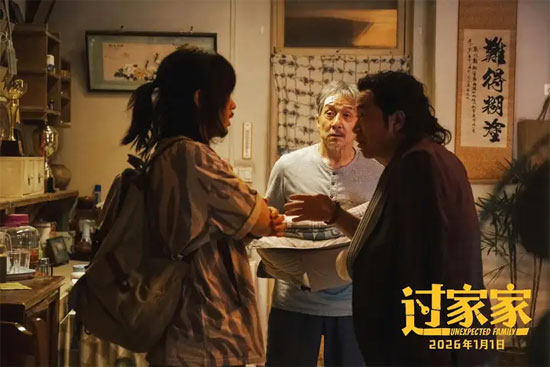
Just from this synopsis, one can grasp how “typical” the film’s narrative structure and thematic content are—and indeed, it is precisely so. Zhong Bu-fan initially agreed to play the son role for free room and board and the chance to earn money; Jia Ye’s attentive care stemmed from profiting off Ren Dad; Su Xiao-yue’s constant visits were motivated by selling health products; Jin Zhen’s tender care for Ren Dad stemmed from her romantic feelings.
All four had ulterior motives and demands for Ren Dad—their intentions were far from pure… Yet:
– Zhong Bu Fan, orphaned young and recently bereaved of his grandmother, found unparalleled paternal affection with Ren Dad;
– Jia Ye, once beaten by debt collectors, received a second chance at life after Ren Dad saved him; Su Xiaoyue, the “brother-obsessed” woman striving abroad, felt more like a daughter when near Ren Dad; and Jin Zhengu, caught in unrequited affection, goes without saying.
Self-interest and pretense exist, yet all this is built upon genuine emotion. Thus, no matter how great the misunderstandings or conflicts, they always find their way back together. No matter how exaggerated their actions, it never feels out of place.
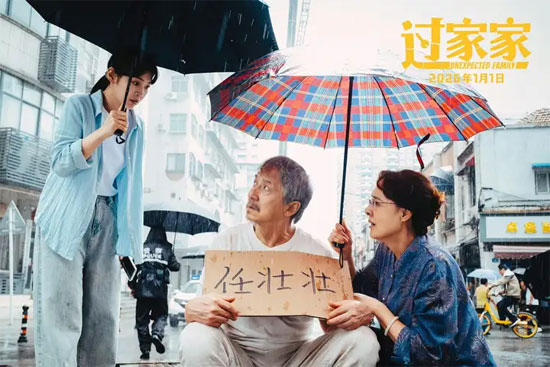
I’ve seen films like this before, and “Unexpected Family” isn’t fundamentally different. It’s not terrible, but it’s hardly outstanding either… The only variable capable of turning this mediocrity into something magical rests entirely on Ren Jiqing/Jackie Chan.
Having always perceived Jackie as an “action star who seizes opportunities for comedy,” I paid extra attention to his performance this time. To my surprise, there was little trace of “acting”—instead, he displayed a more convincing portrayal of aging: The playful grins vanished entirely, replaced by rarely seen confusion, disorientation, and blankness. Even his body language changed—his signature bow-legged running slowed down in both pace and rhythm, and his entire demeanor became relaxed and slack.
In “Unexpected Family,” Jackie no longer plays the big brother who must constantly “put on a brave face.” Instead, he embodies a lonely elderly man deeply troubled by Alzheimer’s disease.
This powerful actor’s embodiment of his character extends beyond Ren Jiqing’s “memory-loss” traits to fully capture his identities as a “failed father” and an “outdated man.”
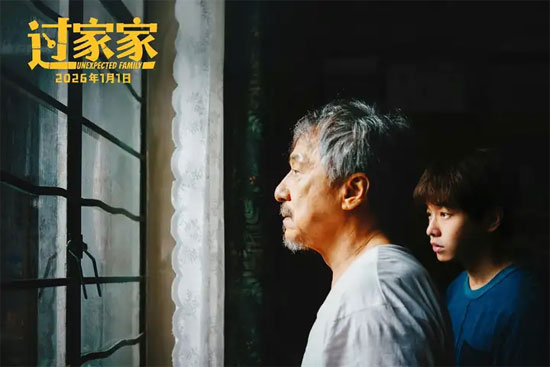
As the “weightlifting exhibition match” reaches its climax, we learn that Ren Jiqing’s claim of his son being a “world champion” is false. The son, following his father’s advice to use a lunge lift, failed and won only silver. This triggers Ren Zhuangzhuang’s rebellion against a lifetime of blind obedience to his father—Ren Jiqing embodies the archetypal father of a bygone era: authoritarian, utilitarian, obsessed with first place (few succeed, countless fail), ultimately driving his son away.
Simultaneously, Ren Jiqing embodies the old-school “macho man who clings to life as long as he breathes” (perfectly mirroring the weightlifting imagery), or in other words, a “paternal figure.” Yet this isn’t entirely pejorative. The opening scene where Ren Jiqing effortlessly helps neighbors move heavy objects explains why everyone respectfully calls him “Father Ren.” However, when this unyielding masculinity is imposed on loved ones, it inevitably brings suffering.
Thus, when Ren Jiqing shifts from “must win” to “do your best,” when he finally admits he can no longer sustain that macho pride, he achieves reconciliation with himself. This solidifies his portrayal as an aging hero whose time has passed.
Just like in the post-credits scene where the family watches a movie together, Jackie Chan teaches the little girl in the back row who was urging him not to take photos to call him “Big Brother.” She calls out, “Big Brother Grandpa”—a sign of Jackie Chan accepting his age and embracing it. He is fully capable of blossoming once more in his artistic life.