Film Name: 翠湖 / As The Water Flows
My cinema viewings for January have already hit double digits, and last night’s domestic drama “As The Water Flows” was absolutely the best film I’ve seen so far—it’s also a strong contender for my top ten picks of the year.
This family-themed slice-of-life film is unlikely to make waves at the box office, but everyone who’s seen it raves about it. Watching it from start to finish, my strongest impression was sheer comfort: vivid characters, authentic life details, meticulous cinematography, and profound conflicts. What truly warmed my heart was the film’s abundance of life wisdom and its overflowing affection for family and loved ones.
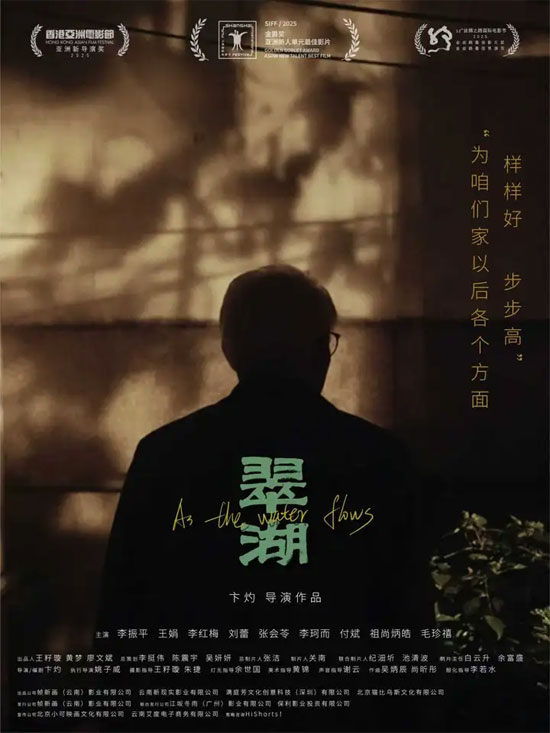
Notably, this film is adapted by first-time director Bian Zhuo from the true story of his maternal grandparents, embodying the saying, “A masterpiece is born naturally, and a skilled hand merely captures it.”
In other words, no one else could have made this “As The Water Flows,” and even Bian Zhuo himself couldn’t create another one like it… Such a naturally perfect and irreplaceable film deserves our utmost appreciation.
Set by Kunming’s Cuihu Lake, the film unfolds a family saga: After a year of widowhood, elderly Xie Shuwen expresses his desire to be with Aunt Wu, sparking fierce opposition from his three daughters. This conflict forces him to confront his own absence within the family. He then embarks on a journey to address the struggles and issues facing three generations, seeking reconciliation and understanding through heartfelt connections.
A major strength of “As The Water Flows” lies in its richly layered and authentic characterizations. Eldest daughter Shuzhen’s family represents ordinary working-class life, second daughter Shujuan’s family struggles as tight-fisted lower-middle class, while youngest daughter Shulin’s family belongs to the affluent class. This creates complex yet relatable dynamics: the relationships among the sisters, within each household, between the three grandchildren, and between Shuwen and his grandchildren all feel deeply grounded in real life.
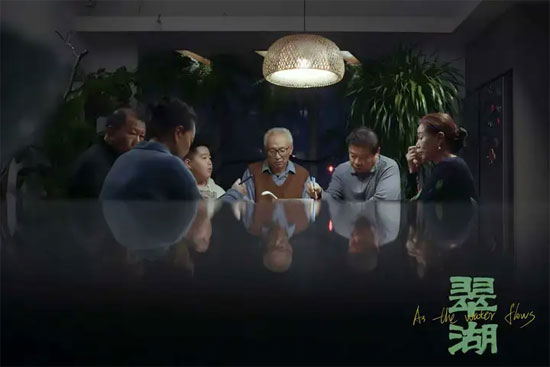
For instance, Shuzhen arranges for her daughter Xiaoqian—who faces “graduation-to-unemployment”—to work at her aunt’s place, but Xiaoqian can’t bear the humiliation of being the “poor relative.” Shujuan and her husband maintain their marriage solely for their son Zilong, forcing him to choose between “it’s all my fault” and “it’s all Mom and Dad’s fault.” Shulin’s household appears most affluent, yet his seemingly model son Yushuo envies the seemingly ordinary Xiaoqian and Zilong, wishing he didn’t have to pretend all the time.
These three small families share a common trait: strong-willed wives hold the reins, while husbands are generally “pushover” (though less so in Shulin’s case, where her husband never appears)— —a trait inherited from their parents Shuwen and Yuanqin’s “strong woman, weak man” family dynamic.
“As The Water Flows” avoids casting anyone as purely positive or negative. It doesn’t shy away from Shuwen’s lack of responsibility during his daughters’ upbringing. The daughters feel emotionally closer to the mother who raised them, forming the basis for their perception of their father as “selfish.”
What I most admire about the film is its complete absence of any attempt to assign blame, measure superiority, or force reconciliation within family dynamics. Many works fall into predictable patterns—criticizing the family of origin, highlighting elders’ hardships, or staging forced reunions… Yet “As The Water Flows” consistently narrates everything from the perspective of family members (rather than their attitudes toward family). For this story to hold, it requires both resentment and, more crucially, love.
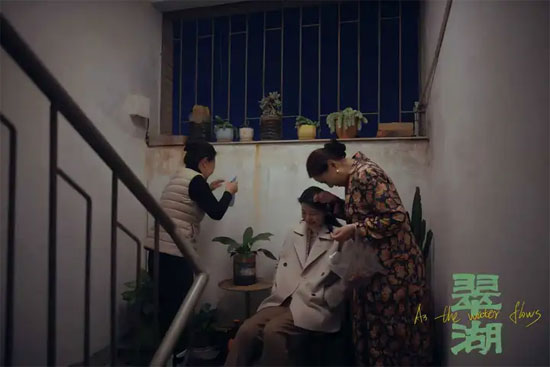
So as I watched the film, I found myself growing more and more fond of it. Upon learning of his poor health and seeing his grandchildren each grappling with their own troubles, Shuwen didn’t resort to imposing authority he didn’t possess. Instead, he sought solutions through his life wisdom and the love he held for his late wife and his descendants.
For instance, he frequently rotates between his three daughters’ homes and his own, recounting stories of his late wife’s assertive youth to Xiaoqian, taking Yushuo out to visit elders, bringing Zilong home for foot baths while catching up with his cousin…
Throughout this process, Shuwen embodies the clarity and insight that comes with age—calm, magnanimous, uncontested, and accepting of fate.
My favorite scene is when Shuwen returns to his eldest daughter’s home and grows irritated by Shuzhen’s cleaning demands. He then discovers he miscalculated during a card game and lost. Shuzhen insists the elderly men playing with her father were ganging up on him, demanding to call and reprimand them. This was a minor incident, and ordinarily Shuzhen’s outburst would have made Shuwen feel humiliated—yet he didn’t stop her. Instead, he even allowed her to make a second call. Rather than avoiding embarrassment in front of friends, he preferred seeing his daughter defend him. Afterward, the two who had been at odds both smiled at each other.
This is the finest embodiment of what I call a “clear-sighted attitude toward life.”
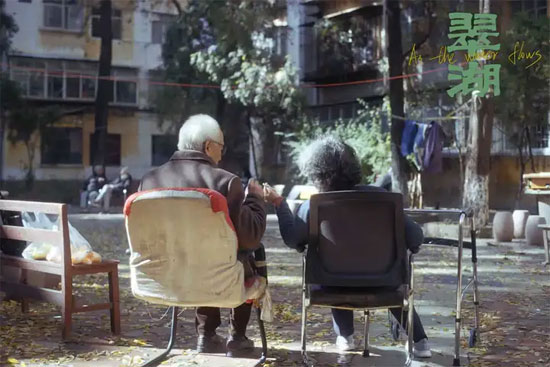
The same holds true for the relationship between Shuwen and Aunt Wu. They simply wanted companionship with someone they found agreeable to talk to. Yet when faced with resistance from their children, they didn’t insist. Instead, they’d “unhealthily” share a cigarette together.
Incidentally, the cinematography in “As The Water Flows” reminded me of my favorite American series, “Better Call Saul.” Both shows frequently employ mirror reflections, reflections, and perspective shots for storytelling—though “Better Call Saul” leans toward more daring camera work, while “As The Water Flows” showcases a more subtle ingenuity in presenting a “gentle objectivity,” simple and unadorned.
The above only scratches the surface of “As The Water Flows”‘s merits, but I feel I’ve covered the essentials. I wholeheartedly recommend it to anyone intrigued—screenings are scarce and hard to find, but catching it when you can will be well worth your time.