Film Name: 熊出没·年年有熊 / Boonie Bears: The Hidden Protector
This title isn’t meant to be sarcastic about other live-action films in the Spring Festival season—I genuinely think “Boonie Bears: The Hidden Protector” (hereafter referred to as “The Hidden Protector”) is a great watch.
I’ve listed some of its strengths: a fresh take on traditional New Year tales, stunning visual effects, well-developed characters with thoughtful themes, and a narrative that delivers contrasts, twists, and climaxes. While it remains fundamentally a “Frankenstein’s monster” of genres, it masterfully blends its elements. In terms of overall polish and execution, it comes remarkably close to the caliber of a top-tier A-list production.
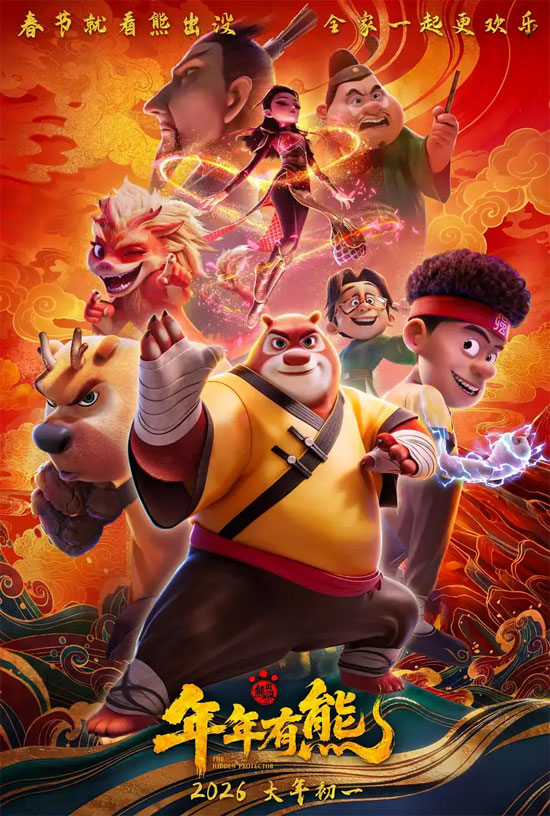
This isn’t to say “The Hidden Protector” is flawless. On the contrary, I could easily list numerous issues. Beyond the inevitable simplifications inherent in children’s animation, the film suffers from unnecessary subplots that make it bloated and sluggish (running nearly two hours)—problems that are hard to overlook… Yet, I anticipated most of these issues before watching.
Moreover, “The Hidden Protector” serves as both a Spring Festival-themed educational film introducing children to traditional customs and an aesthetic primer for young audiences. While thoroughly fulfilling its core purpose, it repeatedly delivers unexpected surprises—earning extra points rather than losing them. This is precisely why I rank it as the best film of the Spring Festival season.
[A lighthearted spoiler divider.]
“The Hidden Protector” marks the first fantasy-themed film in the “Boonie Bears” series following its sci-fi phase. Its first innovation lies in reimagining the well-known folk tale of “defeating the Year Beast during the New Year.”
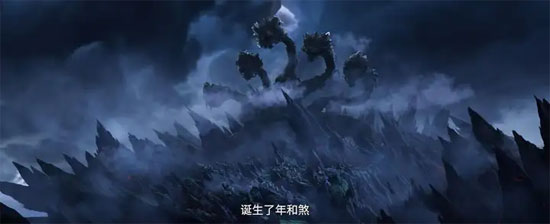
Thousands of years ago, both the Year Beast and the Sha Beast were born. The Sha Beast feeds on humanity’s negative energy, wreaking havoc upon the world, while the Year Beast is the auspicious force that combats and seals the Sha. As for why folklore only mentions defeating the Year Beast and not the Sha—after introducing this premise, the film deliberately leaves it as a mystery, revealing the truth only during the climactic finale.
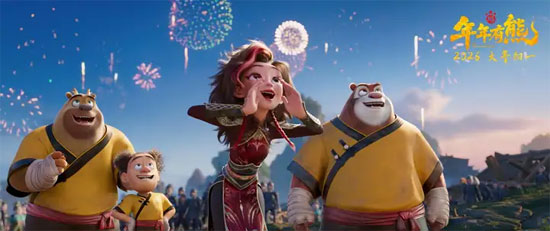
The most striking aspect of The Hidden Protector is undoubtedly its top-tier visual effects. Drawing on extensive experience in adapting mythological, legendary, fantasy, xianxia, and martial arts themes—where domestic animation has accumulated rich expertise and numerous successful precedents—the film achieves remarkable fluidity in action sequences and exceptional detail in its imagery.
Take, for instance, the luminous trails and particle effects when Xiong Da and Nian Nian wield the Xuantian Instrument; the intricate patterns on colossal beasts descending from different dimensions; the layered rendering when protagonists channel elemental powers; or the perfectly aligned, individually defined ice spikes unleashed by General Jiang—each detail left me marveling, “Kids these days are spoiled rotten!”
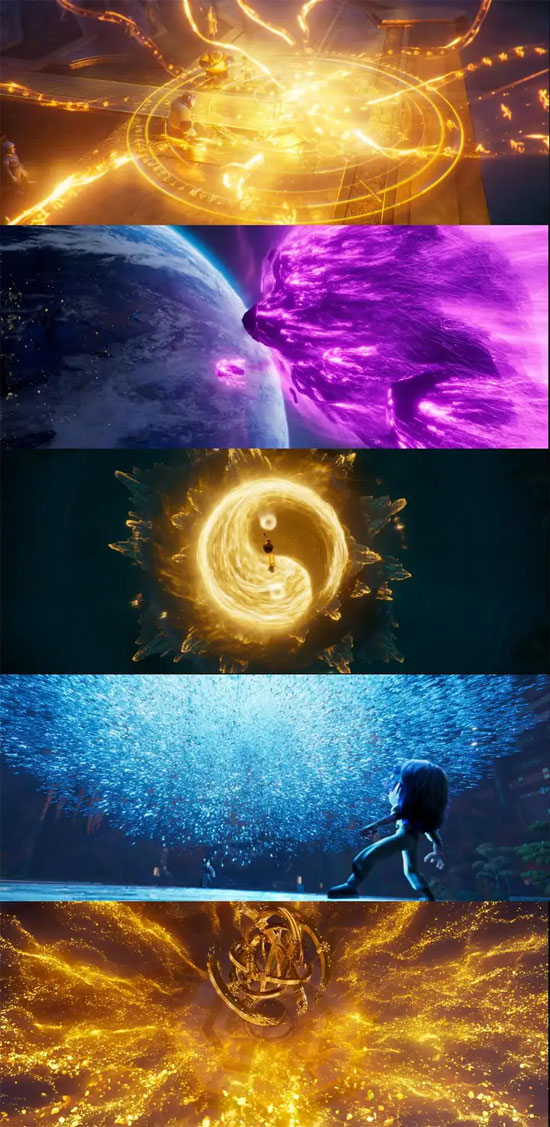
It’s important to note that the production cycle for “Boonie Bears” films typically spans only one or two years—far shorter than the years-in-the-making animation blockbusters like Ne Zha. Achieving the current level of quality is truly exceptional value for money.
Another surprising creative choice in “The Hidden Protector” is its character design. While not always outstanding in the past, this time the characters feel well-developed, even featuring complex, multi-layered arcs. Simply put, the message is: “Don’t belittle yourself or deny your worth just because you haven’t achieved perfection or made mistakes.”
The film uses three characters—two protagonists and one antagonist—to illustrate this truth from different perspectives.
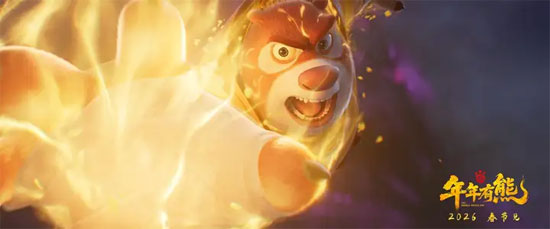
First is Xiong Da, the ever-reliable big brother of Dogbear Ridge. His constant responsibility-taking bred an “I’m indispensable” mindset. After gaining the Year Beast’s power, his dissatisfaction with its weak spiritual combat strength led him to inadvertently break Sha’s seal. His hunger for power stemmed from good intentions, yet his actions caused harm. Ultimately, he let go of his obsession.
Next is Wang Anquan. Born physically frail, he yearned to become a warrior of New Year City. The inevitable psychological gap between his aspirations and reality ultimately pushed him into an irreversible spiral of corruption.
Finally, Niannian, one of Nian Guan City’s two Year Beast rulers, felt inferior to her sister Suisuí—a martial arts prodigy skilled at slaying Sha beasts. Constantly playing pranks and seeking amusement, Niannian grew ashamed of her own inadequacy, even shirking and denying her duty as a Year Beast.
Yet in truth, Niannian—who loved wandering among humans and possessed the power to empathize with them—held the ultimate strength to defeat evil beasts. This brings us back to the truth behind the first Year Beast’s victory: She discovered that positive human emotions could effectively weaken and suppress evil beasts. Thus, she spread a “rumor” encouraging people to “defeat themselves” during the New Year by posting couplets, hanging lanterns, giving red envelopes, and setting off firecrackers—all to ignite the power of unity and goodwill.
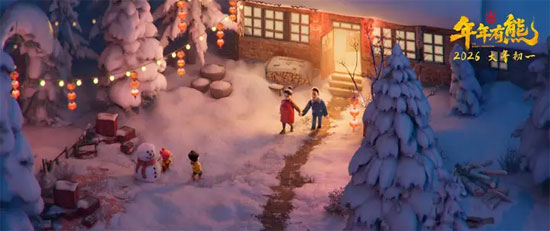
When the evil beast wreaked havoc: A housewife, exhausted from endless chores, berated her husband for not helping with the housework. He retorted that she had no value while he toiled outside to earn money. Passengers stranded on a train ignored the weather conditions and kept scolding the train attendants, who in turn ignored their duties and shouted back. An elderly father criticized his daughter for returning home unmarried and childless, enraging her so much that she slammed her chopsticks down on the New Year’s Eve dinner table and stormed out.
But under the influence of the Year Beast: The quarreling couple showed mutual understanding and agreed to manage the household together; passengers resolved to have their New Year’s Eve dinner on the train, and the attendants served plate after plate of dumplings; the elderly father humbly sought reconciliation with his daughter, and the girl shyly made peace with him.
This is my favorite sequence in The Hidden Protector. Through its newly crafted New Year tale, it vividly captures the joys and sorrows of the holiday season while subtly yet firmly advocating for family harmony and mutual support. Not only did it inspire the children, but even as an adult, I felt warmed by its heartfelt message.
“The Hidden Protector” certainly has its flaws—forced humor that disrupts the pacing, excessive exposition that lacks discernment, a somewhat chaotic blend of elements, and frequent reliance on borrowed ideas. But I won’t dwell on these, because when considering the film’s overall quality, these are minor flaws that don’t overshadow its strengths.
Therefore, if you can accept and overlook these objectively present flaws, I highly recommend watching “Boonie Bears: The Hidden Protector.” It would be even better to bring younger children along—they’ll happily experience their first introduction to the Chinese New Year.