Film Name: 大话西游之仙履奇缘 / A Chinese Odyssey Part Two – Cinderella / 西遊記大結局之仙履奇緣
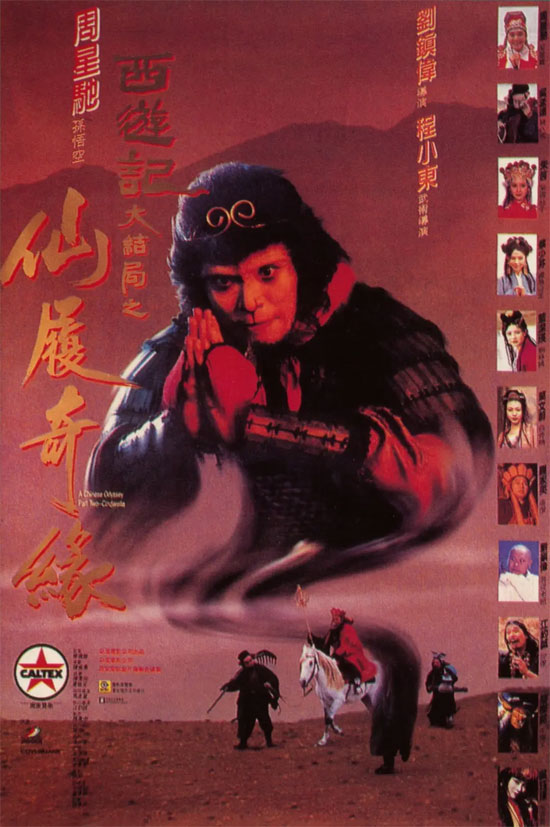
This film primarily tells the story of Zhenzhu Bao traveling back five hundred years to save Bai Jingjing, encountering the Fairy Zixia, developing a romance with her, and ultimately evolving into Sun Wukong. Some say that if you laugh until your sides ache and your face contorts while watching A Chinese Odyssey, then you have a great sense of humor. But if you finish watching A Chinese Odyssey still rolling on the floor laughing, then you haven’t understood anything at all. If, after watching it, you suddenly realize tears have silently welled up on your cheeks, you’ve finally grasped the film’s first layer. If you’ve laughed and cried your fill, then suddenly freeze in place, unsure whether to weep or laugh, you’ve understood its second layer.
This film appears comedic, yet it is fundamentally a tragedy. Only, in our youthful recklessness, we couldn’t see through it. Thus, Stephen Chow is a tragic man, and Irene Chu a devoted woman. That’s why I love this film, yet struggle to digest its sorrow. There exists a kind of love, a kind of farewell—even if you pour your entire life into chasing it, you may never recapture it.
In an instant, the world shifts beyond recognition. Love and hate rise in the sea of suffering, yet we cannot escape this world’s fate, no longer the youths we once were. This film is revered as a classic among classics in the realm of absurd comedy, embodying both the creators’ ingeniously witty humor and the genuine emotional journeys of Stephen Chow, Irene Chu, Karen Mok, and others. Mimi Yim’s portrayal of Zixia on screen captures the romantic spirit of a devoted girl with heartfelt sincerity, yet leaves one aching.
“My true love is a peerless hero who will one day come to marry me riding on a rainbow cloud.” How many young women once held this line as the truth of love. Yet they guessed the beginning but not the ending—a truly heartbreaking tale…