Film Name: 双瞳 / Double Vision
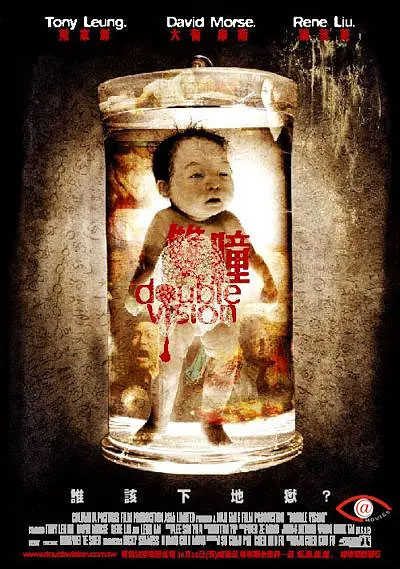
Recently, due to a certain New Year comedy film, “Double Vision” has suddenly been mentioned everywhere again. Many people say the core concept of that film is very similar to “Double Vision.” “Double Vision” is a movie I really like. The first time I watched it, I thought it was chaotic, but years later, I found the details quite intriguing. After watching that film, honestly, it’s not that similar. The premise of using yin-yang and the Five Elements to kill people is really old and commonplace. Like in Seven, countless writers have had their killers do the same thing. It’s hard to pinpoint where the inspiration truly came from. And while the altar in the modern hospital building might seem similar to the Taoist temple in the modern commercial building from “Double Vision,” this altar is so crude that it’s almost embarrassing to even compare them. It feels like an insult to the sophistication of “Double Vision.” If you ask me whether it’s plagiarism, I’d say that killing based on the Five Elements alone isn’t plagiarism. But the overlap between “Five Elements murder + attaining enlightenment and immortality” is indeed a bit too high. Add in the detail of incorporating feudal superstitious architecture into a modern building… I can only say that the screenwriter who actually penned the script probably liked “Double Vision” too. Anyway, the only credited writer is the director. They could’ve borrowed bits from anyone, and without a specific credit, no one can pin the blame on them.
Why is the feudal-style architecture in Double Vision so meticulously crafted? …While both feature hidden levels within modern skyscrapers, Double Vision creates a stark contrast between interior and exterior. Two wealthy, high-tech doctors, after converting to a cult, sold their company for twenty billion (presumably Taiwanese dollars). They then dismantled the entire Zhenxian Temple—unearthed in Jiaozhi—brick by brick and relocated it to Taiwan. You take an elevator to a high floor in a commercial building, enter a lobby with a reception desk and guest sofas. A man reading a newspaper on the sofa and a Taoist receptionist create an initial sense of ancient-modern fusion. Using the fax phone at the front desk, you enter a code. The automatic door opens to reveal a chillingly authentic, fully restored Taoist temple. The fight scenes within are incredibly impactful. That jarring contrast is leagues better than some New Year’s comedy. Think you can become an immortal by building a makeshift platform? Even your suicide pose must’ve been copied from the True Immortal Temple followers killing cops!
But “Double Vision” excels beyond this. Its interpretation of immortality is what truly chills you to the bone, making you want to live a decent life.
Lowbrow horror films rely on gory shots, lights-out scares, and jump scares. High-caliber horror doesn’t just jump out at you—it makes you shudder with chilling afterthoughts. My first viewing of “Double Vision” was ages ago. Back then, I dared not delve deep into it, relying on youthful vigor and abundant yang energy to watch it blindly. I might have even criticized it afterward, calling it nonsense, confusing, and questioning whether the protagonist even achieved immortality—not particularly scary either. Later, when the official version became available on streaming platforms, I revisited it. The online versions heavily edit out the horror and gore, making it easier to focus on the plot. This made it clearer how rich in nuance and genuinely intriguing “Double Vision” truly is.
Attaining immortality is a long-standing feudal superstition (strike through) topic. It succeeds in fantasy novels but fails in reality. Yet Shuang Tong is quite thought-provoking—it reveals the entire process, step by step, cause and effect, right before your eyes. But would you dare to even entertain the slightest thought of imitating it? Probably not.
The hesitation isn’t about following the River Diagram and Luo Shu to slay those damned, lingering demons. Most would boldly take another’s life—after all, the pain isn’t theirs to bear. It’s the other prerequisites.
Huang Huotu asked his teacher what these symbols truly signified. Finally, the teacher slams his desk and declares: “He wants to become an immortal!” He must have suffered a severe illness. Such illness is the prerequisite for immortality—only through profound suffering can one achieve great enlightenment and refine the elixir he seeks. He likely hid away to cultivate.
At this point, most readers envision a reclusive sage: gaunt, prone to coughing, dwelling in a cave amidst green mountains and clear waters, breathing fresh air?
The reality, however, was this: Xie Yali suffered from a brain tumor compressing his pituitary gland and optic chiasm, spreading to both frontal lobes. Surgery was deemed impossible. For years, he lay with eyes closed beneath floor tiles in a Taipei high-rise, confined to a space roughly the size of a coffin. A small faucet provided water, insects swarmed around him, and a large patch of skin had been torn from his abdomen. There, bloodied and exposed, a fungus cultivated by insects thrived.
I applaud the screenwriter’s interpretation. If you want to become an immortal, go ahead—I’m not going.
After commanding her followers to kill five people, Xie Yali needed Huang Huotu to deliver her final journey. Only by having Huang Huotu shoot her could she truly attain enlightenment and become an immortal. Regardless of whether she succeeded, her dialogue remains profoundly thought-provoking. Step by step, she cornered Huang Huotu, weaving layer upon layer of illusions, coaxing him phrase by phrase until he pulled the trigger. When she finally collapsed, she seemed to breathe a sigh of relief, yet uttered: “I’m not afraid. Be brave.”
She was merely a teenager. She pursued her cultivation with unwavering resolve, trudging the arduous path to immortality. Every step was correct, yet she told herself: “I’m not afraid.”
Was she afraid, or not? Was she yearning for immortality, or dreading death?
This is what truly constitutes a high-level script with an open ending.