Film Name: 飞驰人生3 / Pegasus 3
The first film I had my heart set on for this year’s Spring Festival season was “Pegasus 3.” Judging by its presale figures and box office projections, it also seemed like the “safest bet” for most moviegoers.
After watching it, I must admit that while it doesn’t quite match the quality of “Pegasus 2,” it’s still enjoyable and worth recommending. To elaborate: if the first installment in this series was a raw, fledgling effort, the second achieved a perfectly balanced maturity, and the third has now settled into a comfortable formula.
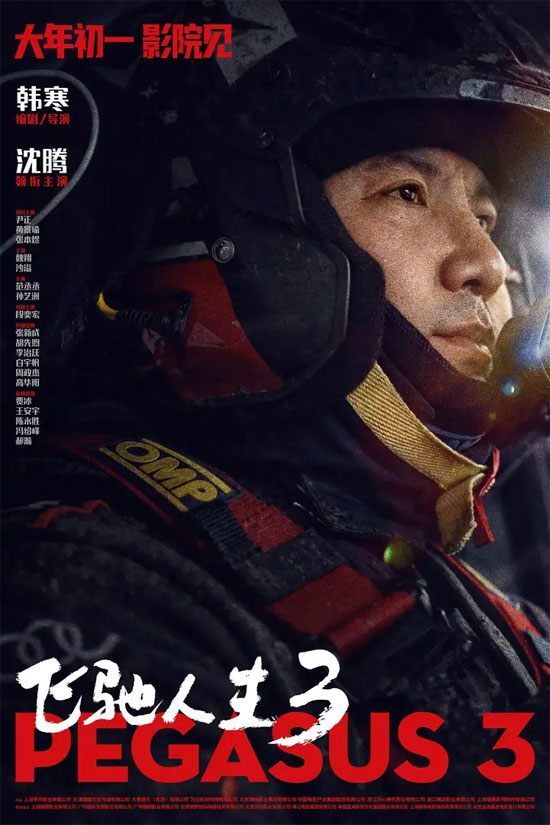
The term “formulaic” carries a hint of disappointment, but it’s not strictly a criticism. After all, the core story of the “Pegasus” series concluded with the second installment. The third film simply finds ways to extend it further. Han Han deserves credit for continuing to leverage his strengths and avoid weaknesses to deliver a solid, above-average work.
That said, Pegasus 3 doesn’t have much new ground to cover. What resonated most with me was its exploration of “the stubborn pride of veterans destined to be left behind by the times, and the dignity of a respectable exit.”
[Spoiler Alert: The following contains plot details.]
Thanks to the “tactical deception” of the early trailers, Pegasus 3 delivered a major surprise that threw me off: I expected it to follow the traditional热血战斗番/运动番 formula—turning enemies into allies, preparing for battle, expanding into grander arenas, and facing more formidable opponents. In reality, the film’s “collective honor” element is surprisingly weak. At its core, it remains a story about resisting injustice and proving oneself.
The Xindi Team won the final Bayinbuluke Rally, yet Director Xin’s Old Man Joy Company shut down anyway. Zhang Chi, Sun Yuqiang, and Ji Xing inherited the site and kept running the auto repair shop. Thanks to their comeback race results, shared prize money, and gigs, they might not be rolling in wealth, but at least they’re set for life.
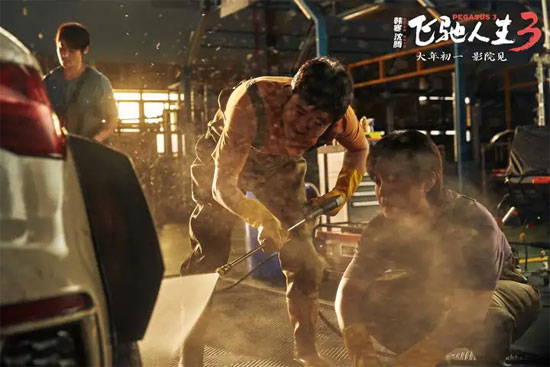
It must be said that Han Han possesses a certain dark sense of humor. He understands all too well how “dreams” serve as a potent lure for men. When Minister An and Bai Qiang approached Zhang Chi under the banner of “forming a Chinese team,” the latter was bound to take the bait.
The most challenging and regrettable aspect of “Pegasus 3” lies precisely here: it needed to redesign an unfair system to rebel against, yet it couldn’t replicate the gradual, organic accumulation of systemic injustice seen earlier. Consequently, it resorted to introducing more common, effective, yet flimsier antagonists—big capital, well-connected individuals, and resource-rich players.
In practical terms, this narrative device achieves neither great success nor failure. Despite its “national” designation, “Mid-Speed Ladder” remains fundamentally a commercial enterprise. Unlike riders like Zhang Chi and Yu Qiang, who merely pay lip service to loyalty, Bai Qiang undergoes a genuine moral descent. To secure funding and technology, he willingly sacrifices his professional integrity.
The formula may be predictable, but at least it charts a clear path forward.
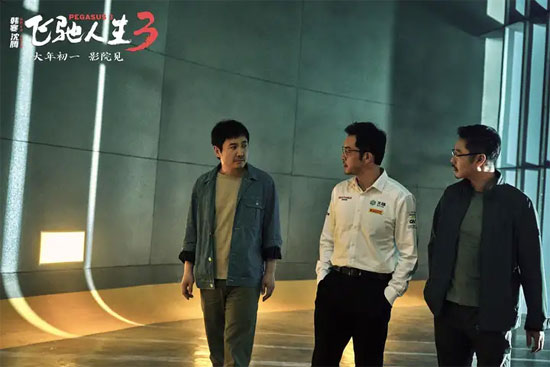
In this storyline, I particularly enjoyed Manager Ye’s entry into the plot. He finally transitions from being a peripheral figure and antagonist in the first two installments to becoming a teammate of Zhang Chi and the others. Beyond his comedic role, his new identity is clearly defined—as the “villain.”
This not only means he can use his insider knowledge to expose the industry’s underhanded tricks, but also equip idealistic good guys like Zhang Chi, Yu Qiang, and Ji Xing with teeth that can bite—from a more pragmatic, utilitarian perspective.
Setting aside its somewhat underwhelming narrative, when “Pegasus 3” shifts into its racing sequences (action scenes), the film once again demonstrates its mastery in this niche genre through professional-grade visuals and pacing. Whether you find it formulaic or satisfying enough, one thing is undeniable: the racing is genuinely thrilling.
The climactic Mu Chen 100 Rally race sequence spans nearly half an hour. Han Han masterfully crafts a rollercoaster of tension through dual storylines—Zhang Chi and Lin Zhendong’s individual driver narratives—and contrasting race routes (southern and northern tracks with distinct terrain). Layered with pre-race tactical planning and on-track emergencies, he builds an atmosphere thick with unexpected twists and turns.
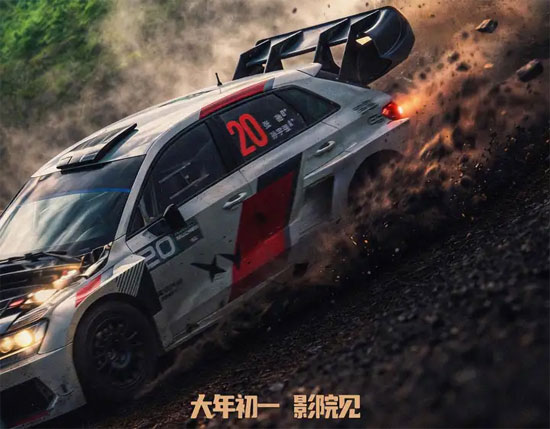
The planned tactical execution centered on a “declare south, execute north” tire-swap strategy—the rapid tire-changing skills of Ji Xing and his crew were consistently underestimated, as rally racing traditionally disregards such precision. Yet the protagonists exploited this very mindset, After the start, they accelerated relentlessly without regard for wear, boosting the average speed of all cars. Then, through tire changes, they executed the tactical concept of “trading time for condition,” seizing an opportunity for parity amidst overwhelming disadvantage.
Moreover, before their opponents could decipher their strategy, Zhang Chi’s reckless, wild-dog-like driving style symbolized their defiant roar of refusal to accept defeat.
An unexpected emergency arose when entering the gravel section: the car’s hood flipped up, blocking 90% of Zhang Chi’s vision. Unable to stop, he relied solely on the narrow sliver of sight and Yu Qiang’s pace notes to navigate, while the car suffered a cascade of issues like increased aerodynamic drag. The film even inserted a callback joke to “Pegasus 2” here: “Good news—cooling efficiency up 100%.”
Despite these disadvantages, Zhang Chi and Yu Qiang, guided by Ji Xing’s reminders and Manager Ye’s instructions, relied on their rich experience and quick thinking to outmaneuver the Indonesian and Indian teams. They managed to shake off the hood, then began chasing down and overtaking their rivals—a truly tense and thrilling sequence.
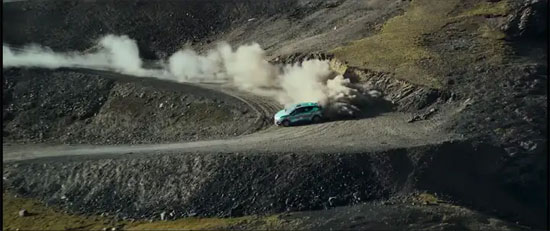
Regarding the racing sequences in “Pegasus 3,” I find little to criticize. However, compared to its predecessors (especially the second installment), it lacks the slow-motion close-ups and the poetic, lyrical depth that captured the emotional intensity.
This shift can be viewed from two angles: from a purely racing perspective, this approach is more professional and composed; yet from the standpoint of universal emotional resonance, for the general audience less familiar with motorsports, it actually diminishes the film’s already limited emotional impact.
Compounded by the “underdeveloped injustice/antagonist” I mentioned earlier, “Pegasus 3″—as a film theoretically designed for pure thrills—feels less exhilarating than it could have been.
Finally, let me share my deepest reflection on this film: how should a veteran, destined to be left behind by the times, meet his end?
Zhang Chi, the self-made driver with no pedigree or complex connections, is a true “natural prodigy.” Even with the latest technology, the younger generation couldn’t match him. Yet consider this: drivers like Li Lun and Chi Haisheng, whose skills aren’t as exceptional, have already significantly narrowed the gap with Zhang Chi thanks to new technologies like SS8. What if technology advances further, or if drivers become even more skilled?
A master of extraordinary talent is utterly unique and impossible to replicate, while cutting-edge technology and secondary-tier experts can be mass-produced—especially in a specialized sport like racing… Thus, Zhang Chi in the film truly becomes the ideal sacrificial pawn.
If a legendary veteran is destined to step down, how should we arrange his farewell? “Pegasus 3” first demonstrates the wrong approach: treating veterans like scrap metal to be discarded, like kindling to be burned, knocking them off their pedestals and trampling them into the mud. Like team leader Zhang Chi, forced to take the fall and resign, or the champion race car ejected into the valley…
A veteran should die in battle, showcasing every ounce of skill, spirit, and glory before the end. They should become a beacon and nourishment for new recruits, radiating the majesty and brilliance of their former glory as a god of war.
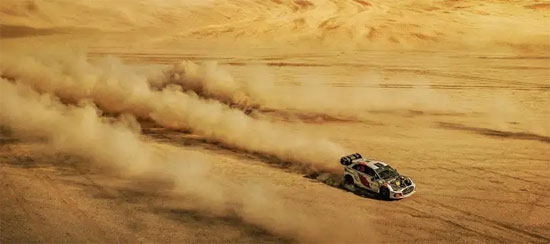
Thus, at the conclusion of “Pegasus 3,” what remains etched in my memory is not Zhang Chi and his teammates ascending the podium, but that race car—completely wrecked after crossing the finish line. Through a hundred battles in the yellow sands, clad in golden armor, They vowed not to return until Loulan was conquered.